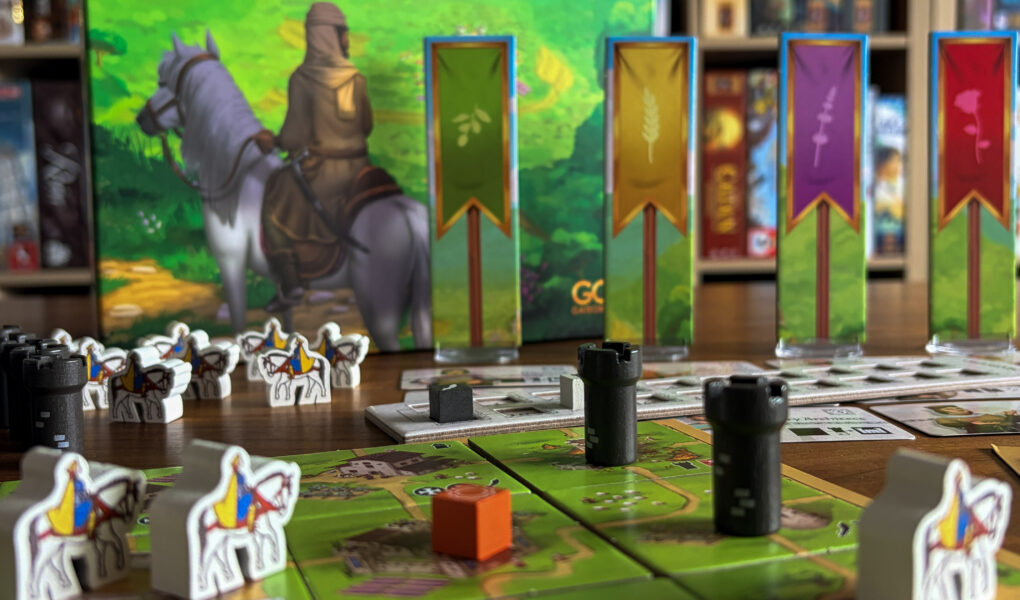

Summary
👥 A game for 2 to 4 players
⏳ Playing time is 45 minutes
🏢 Publisher is GateOnGames

Introduction
In 890 Anno Domini, you step into the role of a local lord in Provence, in a time where prosperity and danger go hand in hand. As you work to build your domain with crops, buildings, and influential figures, the Saracens are constantly watching, waiting for the perfect moment to strike.

Let’s get it on the table
In this game, each player builds their own 3×3 kingdom around a central castle. Over the course of 8 rounds, you collect tiles, create combinations of crops, and attract important characters that strengthen your strategy. Players take turns resolving their entire turn before passing it on. Each turn consists of four phases:
- Take a tile
- Place the tile in your kingdom
- Check for trios
- Check for invasions
By the end of the game, your kingdom will consist of exactly 9 tiles: your starting castle plus 8 placed tiles. While each turn follows the same structure, the choices you make within those steps fully shape your strategy.
Action 1: Take a tile
You choose one tile from the available display. This can either be a land tile from the vertical column or a special building tile from the horizontal row. If you take a land tile from the bottom of the column, it’s free. Want a tile higher up? Then you pay 1 coin for each tile you skip. Any coins already placed next to tiles are collected when you take that tile.
Afterward, the remaining land tiles slide down, and a new tile is drawn from the stack to refill the offer.
If you choose a special building tile, you pay 4 coins and place 1 coin next to each land tile in the column. Then you take the selected special tile.
Action 2: Place the tile in your kingdom
You place the chosen tile on an empty space in your 3×3 grid. It does not need to be adjacent to other tiles. After placing it, you immediately resolve all symbols shown on the tile. These can include:
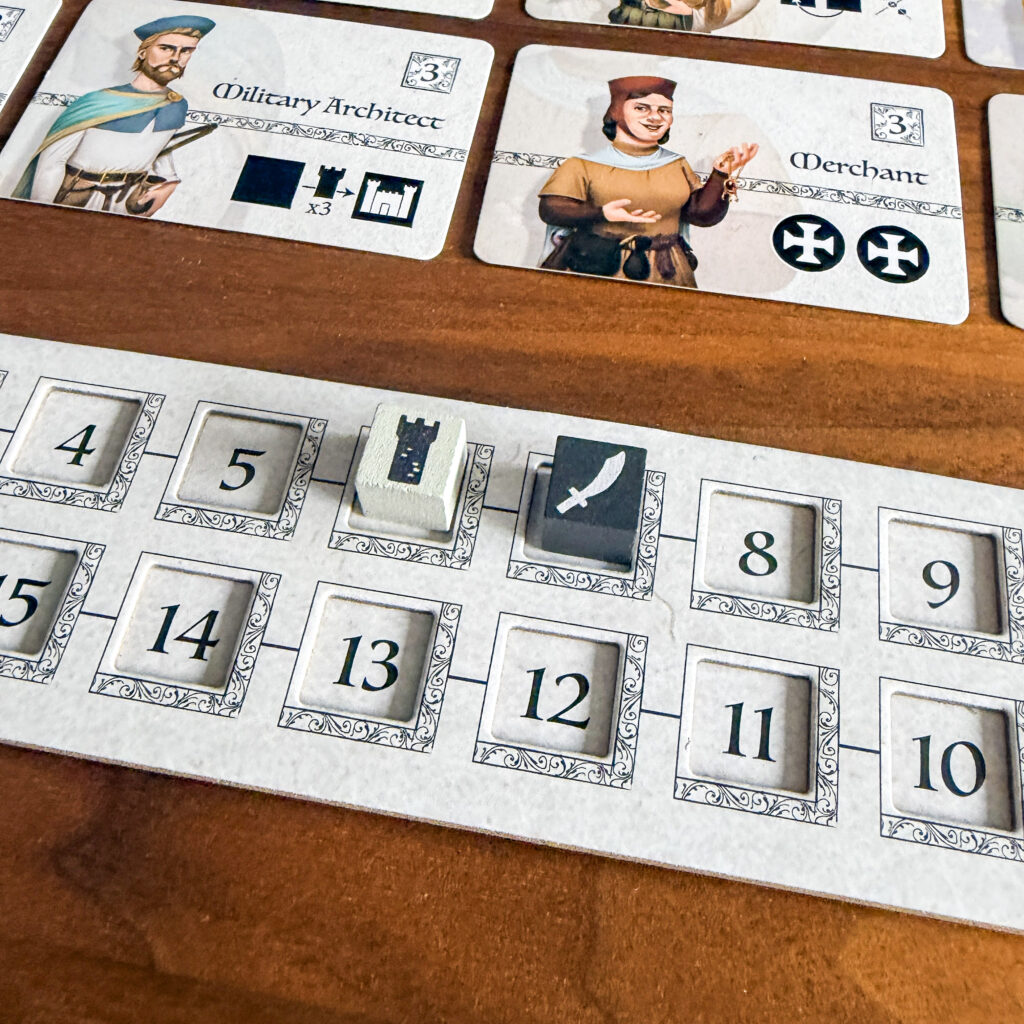
- Placing towers and advancing the defense marker
- Advancing the attack marker
- Gaining nobles or coins
- Making other players pay (for example through churches)
- Some tiles provide endgame points or bonuses that only score later
Action 3: Check for new trios
After placing your tile, you check whether you have formed a trio of 3 identical crops (horizontally, vertically, or diagonally). If you have created a trio, the following happens:
- You choose a character card from the corresponding Banner (color)
- You place it next to your board
- You immediately resolve its ability
Characters provide either immediate benefits, ongoing effects, or endgame scoring bonuses. If you cannot or choose not to take a card, you gain 2 coins instead.
Action 4: Check for an invasion
If, during your turn, the attack marker has moved past the defense marker, an invasion occurs. The player or players with the fewest towers must now choose one tile and remove all towers and or nobles from it. Then the tile is flipped over into a Ruin. After this, adjust the defense marker again..

Final Scoring
Once all kingdoms are complete with 9 tiles, the final scoring begins.
You add up all points from your tiles and character cards. Depending on the chosen scenario, players also receive bonus points for having the most (and second most) nobles, the most (and second most) towers, or the most (and second most) coins.
After that, you resolve any additional bonuses and effects, such as multiplier tiles (X per element) and special character abilities.
The player with the most victory points wins the game..

Final Conclusion & rating
Weight: 1.86/ 5
Replayability: 8
Our rating: 7 out of 10 dices
890 Anno Domini feels like a delightful mix of puzzling and tension. The tile placement is accessible and fairly open, but the decisions are far from simple. Which tile do you choose from the available options? Not every tile will always fit perfectly, so you’ll need to adapt your strategy on the fly, and even your coins can play a key role in that decision-making.
What really makes the game stand out is the constant threat of invasions. You’re never completely safe, and that adds weight to every choice you make. Do you focus on expanding your kingdom, or do you first invest in building a solid defense?
Interaction is present but minimal. You influence each other mainly by taking tiles or characters, and sometimes through the invasion track, but it never feels overly direct or intentional. Most of the time, you’re simply focused on choosing the best possible tile for your own kingdom.
890 Anno Domini is not a heavy game, but it is a very enjoyable tactical experience with plenty of variety and scenarios, offering more than enough replayability.
🙏 Thanks to GateOnGames for providing this review copy and the opportunity to write about it.