Summary
👥 A game for 2 players
⏳ Playing time is 20 – 45 minutes
🏢 Publisher is Ludivore Games
Introduction
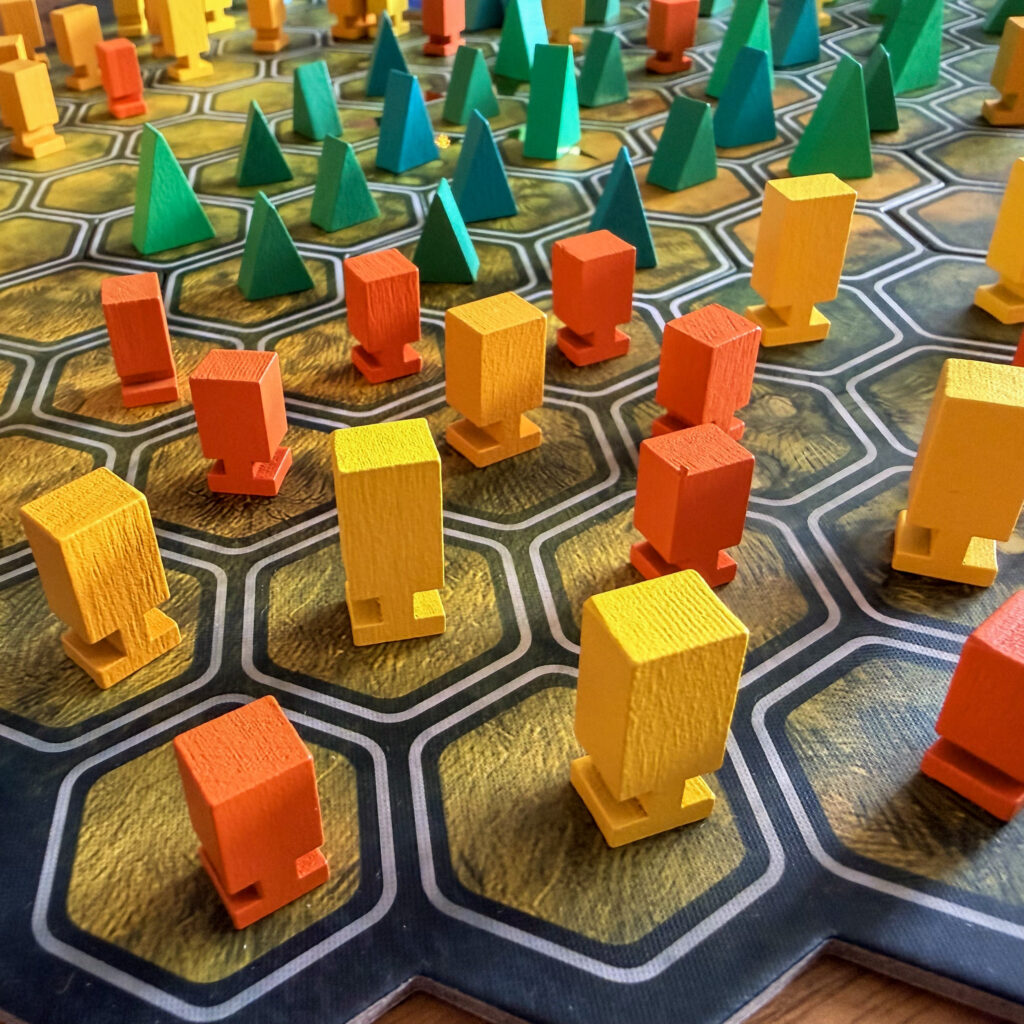
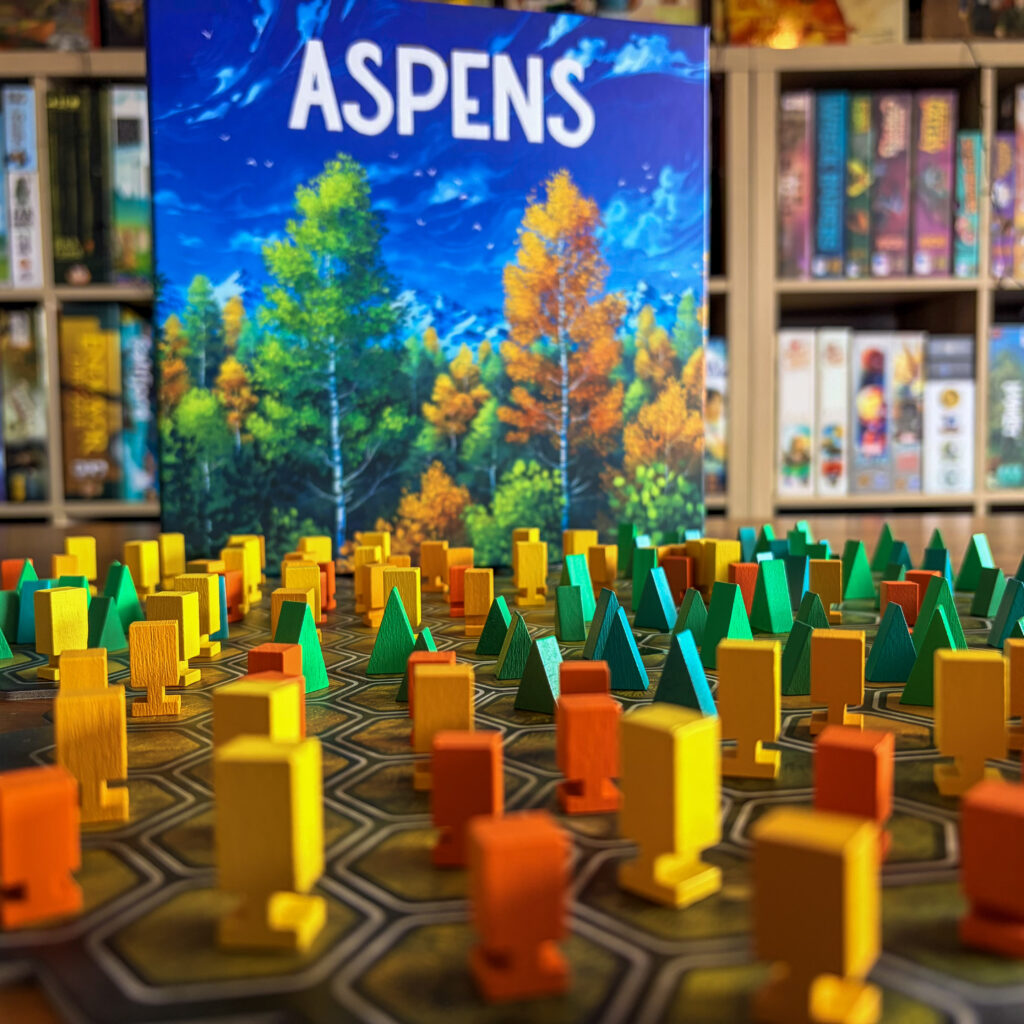
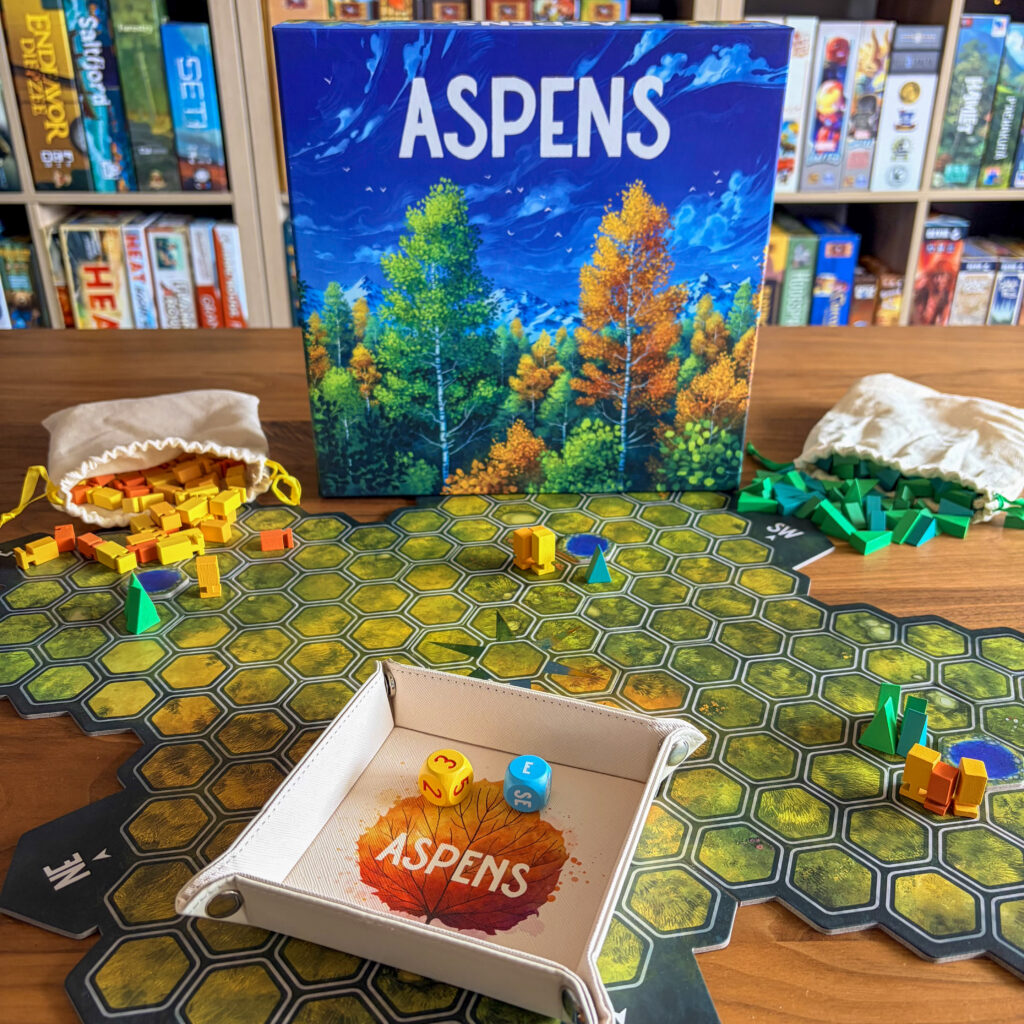
Aspens is a small, cozy forest game… but don’t let that “cozy” fool you. Beneath its calming theme of growing trees and gently flowing water lies a surprisingly tactical duel where every move matters. In this two-player game, everything revolves around cleverly growing your forest, making smart use of sun and wind, and expanding your territory at just the right moment. The goal is simple: claim the most spaces on the board by strategically placing and expanding your trees.

Let’s get it on the table
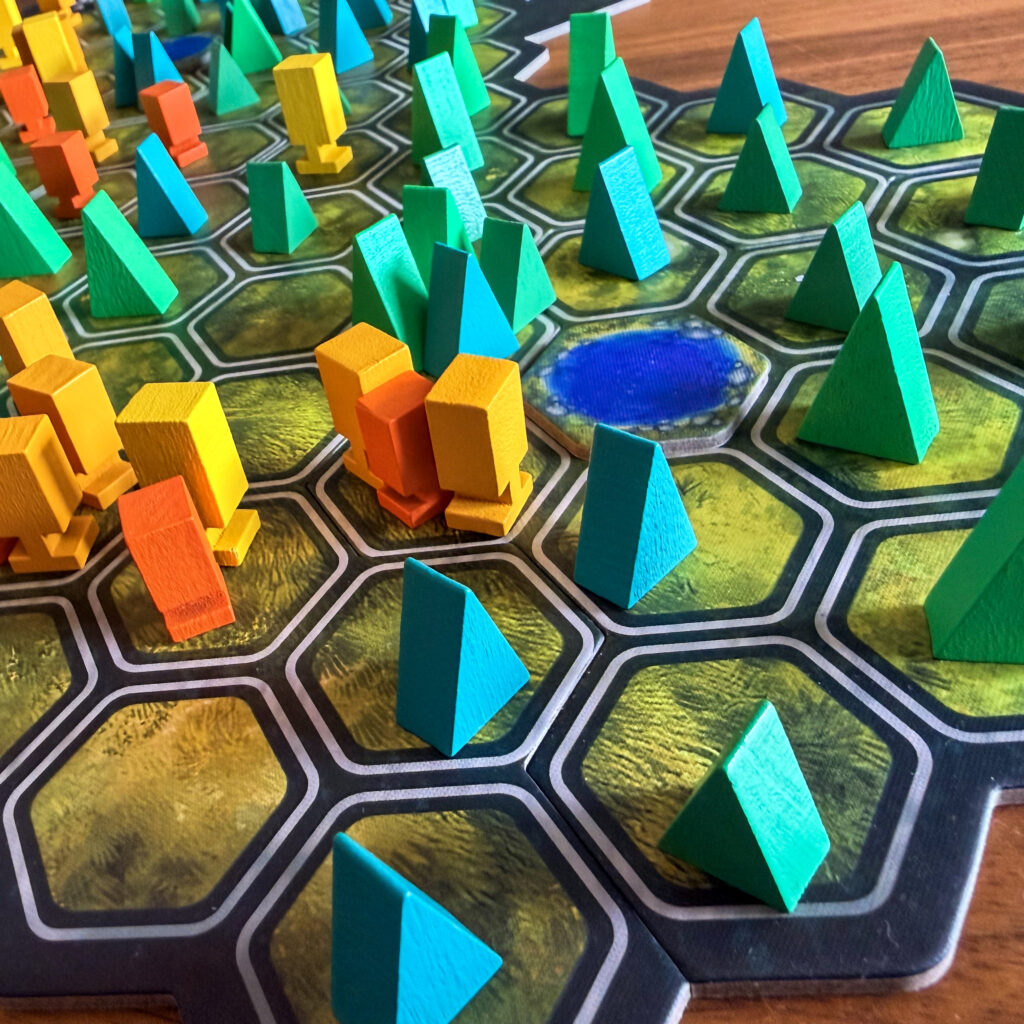
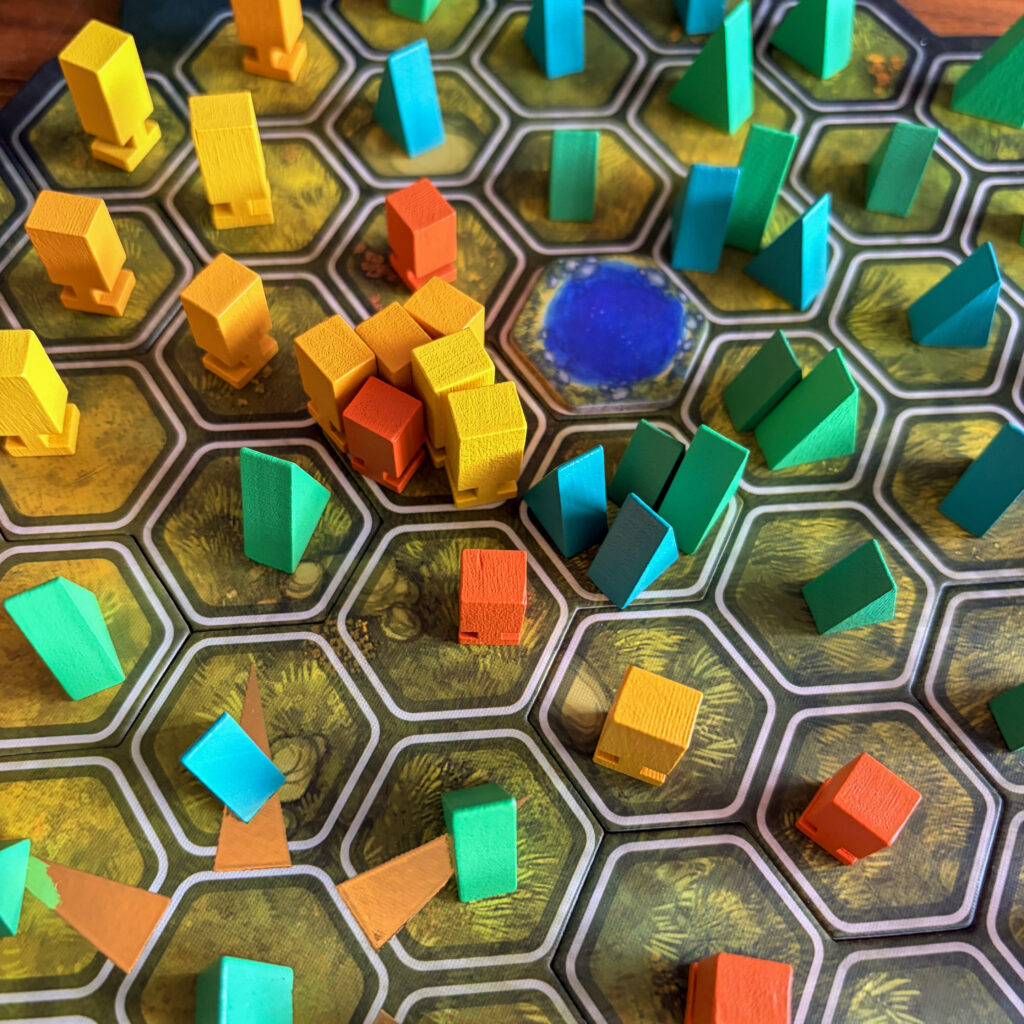
Both players start by sowing their first three trees, each placed next to a water tile. After that, both players receive 4 additional trees, which must be distributed across the 3 spaces where they just planted their initial trees. You are free to decide how many trees you add to each space. In short, after these two steps, you will have 3 spaces adjacent to water tiles and a total of 7 trees on the board.
The flow of the game is clearly structured and consists of repeating turns, each made up of four fixed steps.
Step 1 Roll the two dice: one for the sun and one for the wind. The sun determines which of your areas will produce new trees.
Step 2 Collect trees: You now look at all your spaces and check which ones contain at least as many trees as the value rolled on the sun die. Each of those spaces gives you exactly one new tree from your supply. If you are the active player, you receive an additional bonus tree. During this step, the non-active player also performs the same check and collects trees, but without the bonus.
Step 3 Plant new trees: You have two options here:
Option 1 is “grow up”; For each tree in your hand, you can choose to add it to a space you already control. This means placing the tree onto a space where you already have trees. By doing so, you increase the strength of that space, because the more trees it contains, the higher the chance it will produce new trees in future turns.
Option 2 is “grow out”; You place a tree on an empty adjacent space, but only in a direction allowed by the wind die. The die determines three possible directions: the rolled direction and the two adjacent directions. In practice, this means you expand from a space you already control by placing a tree onto a new space. That space immediately becomes yours, and you can even continue expanding from it within the same turn. This can create chain reactions, allowing you to make multiple expansions in a single turn and potentially claim a large area.

Step 4 Check for Cascades: During expansion, an interesting mechanism comes into play: the so-called “cascades.” If you manage to completely enclose an area so your opponent can no longer access it, you immediately get to fill that entire area with your trees for free. You simply take trees from your supply and place one on each space within the enclosed area. This feels like a huge reward and can instantly shift the balance of the game, especially if you manage to enclose a large section of the board.
On your turn, you always perform these four steps in this exact order. After your turn, it’s your opponent’s turn, and play continues like this until the game ends.
The game ends as soon as the board is completely filled, meaning there are no empty spaces left.
Final scoring is refreshingly straightforward. You simply count how many spaces you control. In practice, you first remove all extra trees from each space so that only one tree remains per space, and then count how many trees you have on the board. That number is your score. The player who controls the most spaces wins the game.

Final Conclusion & rating
Moeilijkheid: 1.69/ 5
Herspeelbaarheid: 8
Onze score: 8,5 van de 10 dobbelstenen
Aspens is highly accessible and, thanks to its short yet very clear rule set, still offers a surprising amount of depth. The rules are easy to grasp, but the decisions you make constantly feel meaningful. Do you focus on building strong, productive areas, or do you push for rapid expansion across the board? Can you pull off a bold cascade at just the right moment? The dice add enough variety without making the game feel chaotic, and because you can gain trees both during your own turn and as the non-active player, you’re always involved. This also keeps the luck factor from ever becoming overwhelming.
Right from the start, you’re faced with an important decision: do you cluster your trees in one area to strengthen growth, or spread them out for more opportunities, but with greater risk since it may result in fewer trees gained?
Aspens feels like a lightly competitive game, but there’s a constant tension between building up and expanding outward. Throughout the game, you’ll continuously get in each other’s way by placing trees cleverly and cutting off space. The moment you successfully create a cascade is especially satisfying.
All in all, Aspens is a very enjoyable and beautifully designed two-player game. It plays quickly, yet remains engaging, and invites you to explore different strategies. An ideal choice for players who enjoy spatial thinking, tactical decisions, and a game that looks simple at first but reveals more layers the more you play. There are also several expansions available, and we’ll tell you more about those soon!
🙏 Thanks to Ludivore Games for providing this review copy and the opportunity to write about it.