
👥 A game for 2 – 4 spelers
⏳ Play time is around 20 – 40 minutes
🏢 Publisher is IELLO

Introduction
Legendary heroes, epic battles, and endless combos! Pick your hero, play your cards, and see if you can defeat your opponent in Unmatched!
Let’s get it on the table
In Unmatched, you take on the role of a legendary hero or heroine. These characters come from movies, books, or even ancient legends. Heroes from different sets can be mixed and matched on any game board of your choice, making every game feel different.
Each hero has their own deck of action cards with unique abilities that fit their character. Will you be able to defeat your opponent together with your hero?
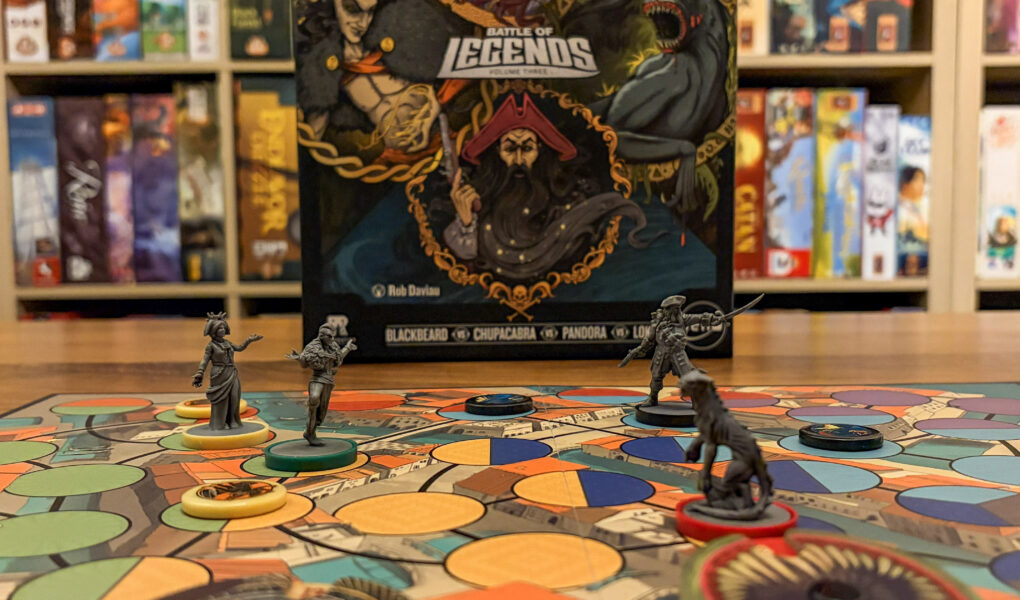
In Unmatched: Battle of Legends, Volume 3, you can step into battle with the following heroes:
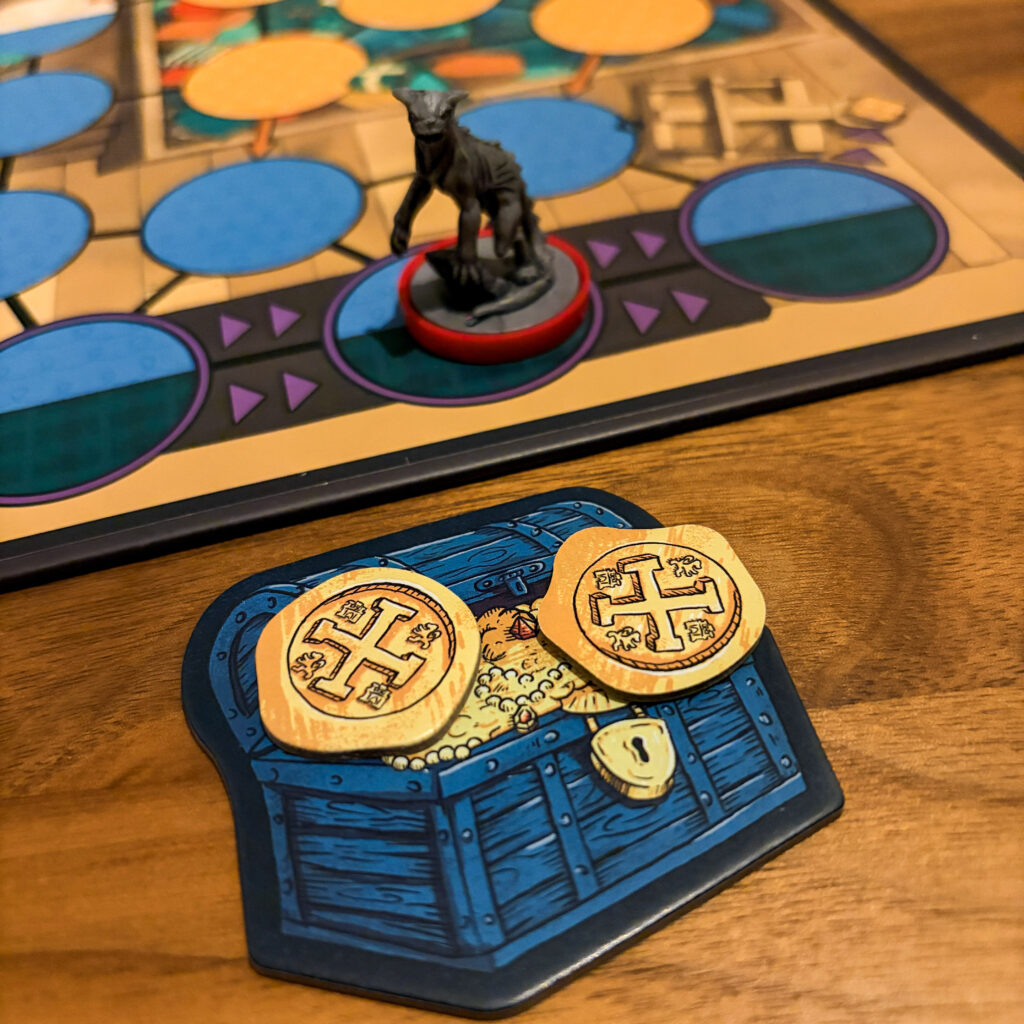
– Blackbeard ; uses three doubloons during the game. At the start of the game, place the treasure chest next to your opponent and put one doubloon on it. Keep the other two doubloons in your supply. When you spend a doubloon, place it on the treasure chest. If your opponent pays doubloons or if you steal them, take them from the treasure chest and place them in your supply. Many of Blackbeard’s cards feature an effect written in gold text, followed by a gold icon. This means the effect only occurs if your opponent chooses not to pay the required number of doubloons. The opponent decides whether to pay or not. If they pay, the effect is prevented; otherwise, the effect is resolved. At the start of your turn, you may pay 1 doubloon to gain an additional action. You can only do this once per turn.
– Pandora ; carries a mysterious box she cannot resist opening. While it holds great power, it also risks unleashing misery upon the world. Pandora’s Box consists of a separate deck of seven cards, also known as “misfortunes.” During setup, place this deck next to your main action deck. These cards are never added to your hand. Each Misfortune card shows a number of feather symbols, ranging from 0 to 2. At the start of your turn, reveal the top card of the Pandora deck and resolve its effect. Then you may choose to stop or reveal another card.
You may continue revealing cards until you decide to stop, or until a total of three or more feather symbols have been revealed. If this happens, you must immediately stop, and Pandora takes damage equal to the number of revealed Misfortune cards (not the number of symbols). After resolving Pandora’s Box, take your turn as normal. At the end of your turn, shuffle all Pandora cards to form a new deck.
– Loki; relies on tricks to outsmart his opponents. Each of Loki’s action cards with the word “Trick” in its name has a unique effect, depending on when it is played. All Trick cards can be used by any fighter. When you play a Trick card, it goes to your opponent’s hand during the cleanup phase instead of your discard pile. Your opponent may play these cards as if they were their own. After being played, the cards are placed in your discard pile. Whenever a Trick card is discarded for any reason, you may choose to take it into your hand or place it on top of your draw pile instead of your discard pile.
Additionally, Loki gains +1 movement for each Trick card currently in your opponent’s hand.
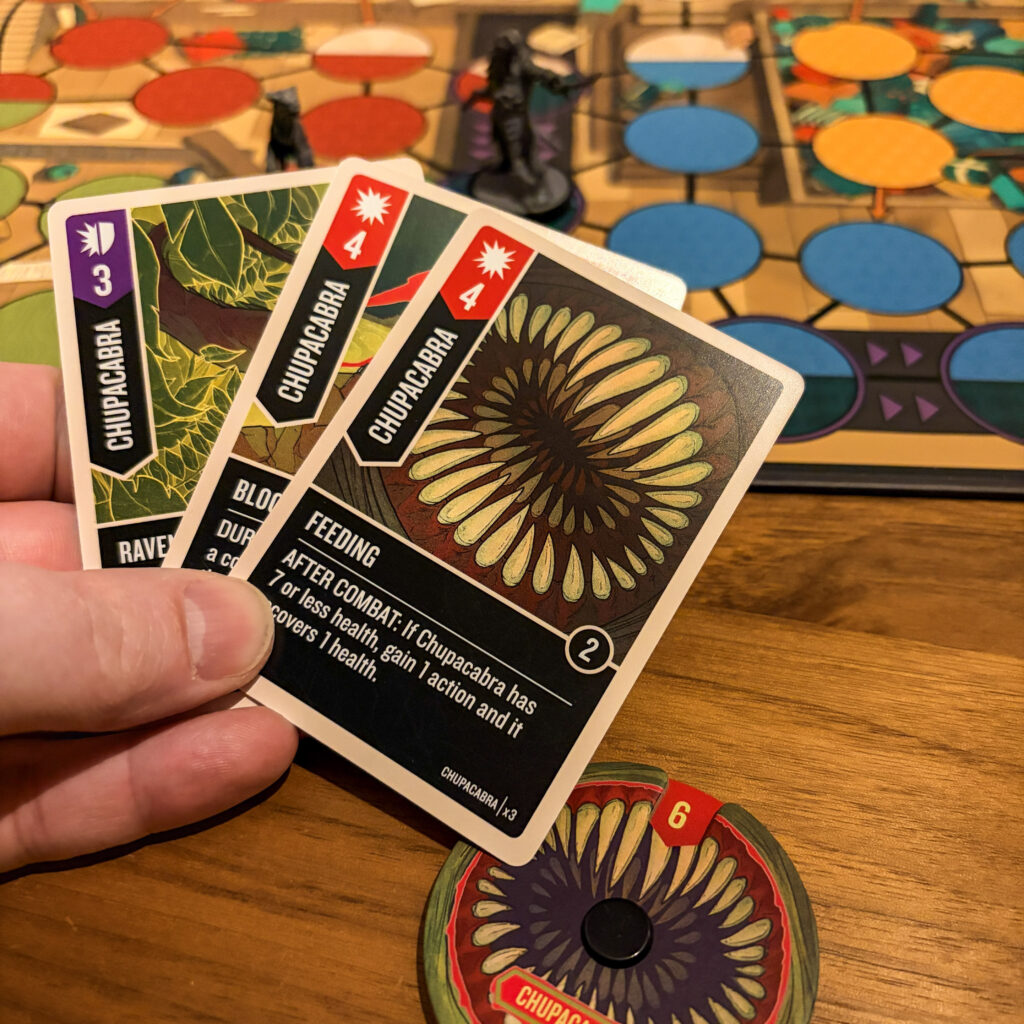
– Chupacabra; Whenever you attack, you may draw 1 card. This effect resolves at the end of combat, after all “After Combat” effects have been completed.
Some heroes are supported by one or more sidekicks, but this is not the case for every hero.
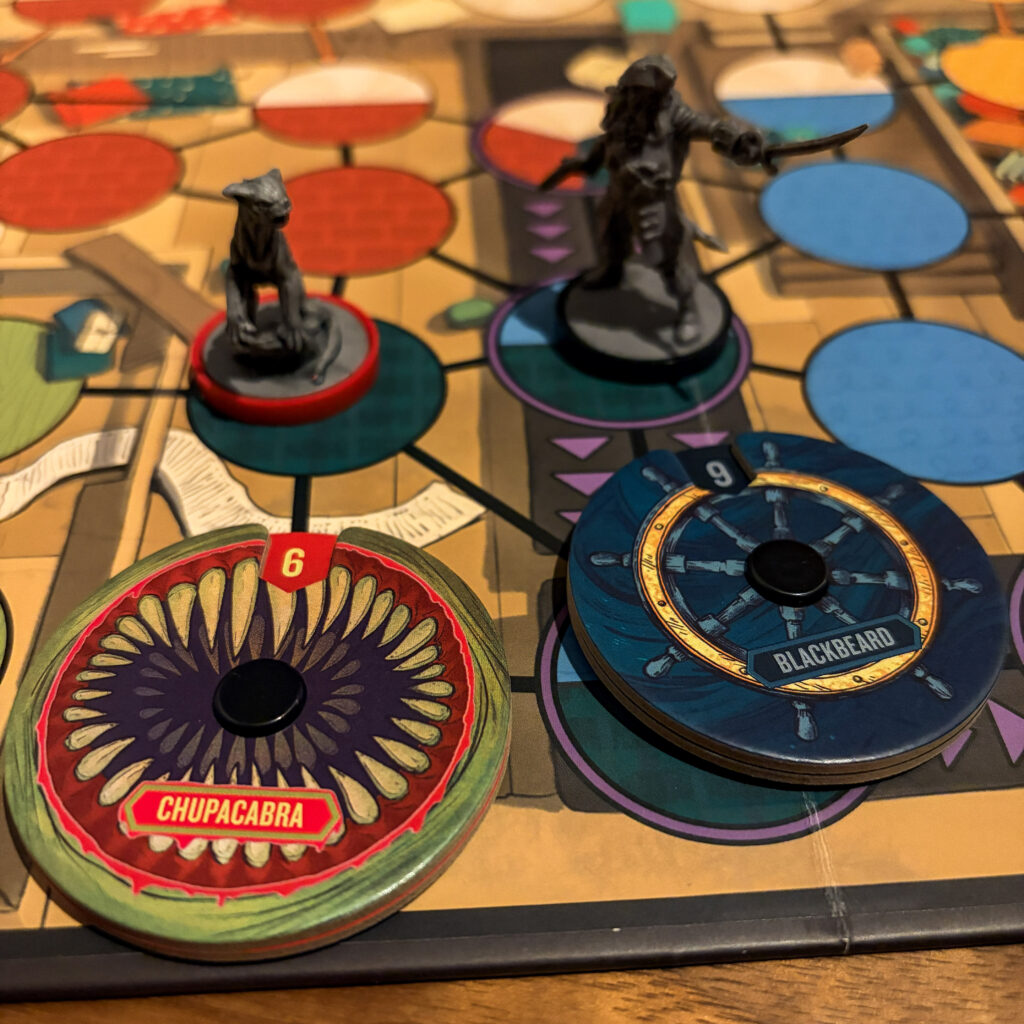
Each hero has their own deck of cards, along with a character card. This card shows the hero’s special ability, as well as the health values for both the hero and their sidekick(s). Health is tracked during the game using health dials for the hero and, if applicable, for a single sidekick. If a hero has multiple sidekicks, each of them has 1 health by default.
The game board Santa’s Workshop has two special effects. One effect is that if a fighter is standing on certain spaces, they are moved along the path at the end of that player’s turn, eventually leading to the “gift trash” area at the end of the track. Additionally, some spaces are connected by orange arrows. Movement between these spaces is one-way only, following the direction of the arrow.

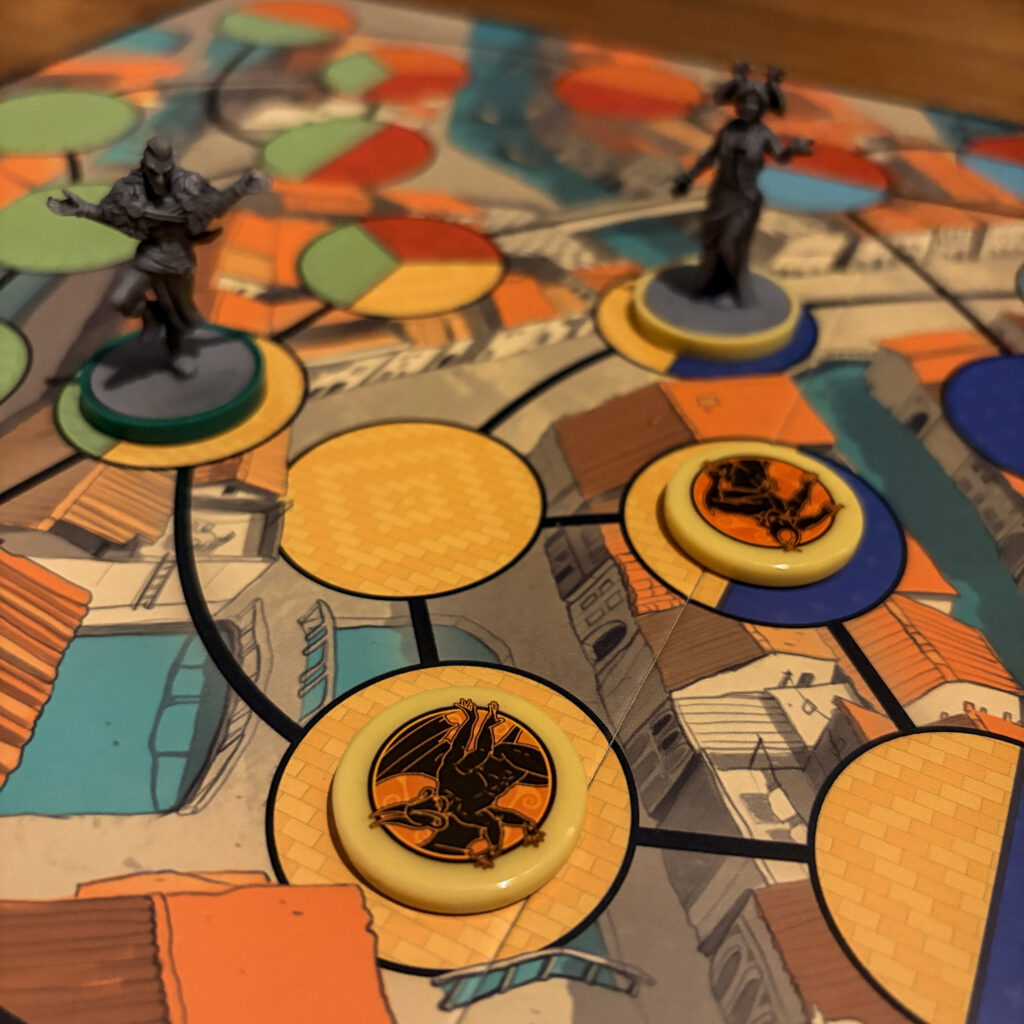
The box includes a double-sided game board. Choose the side you want to play on, regardless of which heroes you select. The board consists of circular spaces that fighters (heroes and sidekicks) move across, and each space can only hold one fighter at a time.
The spaces are connected by black lines, making them adjacent. This is important when your hero can only attack adjacent enemies, or when resolving certain card effects.
The board is also divided into different zones, separated by colors and patterns. Spaces with the same color or pattern belong to the same zone, even if they are located in different parts of the board.
If a space contains multiple colors, it belongs to multiple zones. Zones are important when determining valid targets for attacks and for resolving certain card effects.
Each player then chooses a hero and receives:
- 30 action cards
- A character card
- Sidekick(s)
- One or more health dials
Each player sets their health dial(s) to the starting value shown on their character card, including those of their sidekicks.
Then, each player shuffles their action deck and draws 5 cards.
Next, the youngest player begins placing their hero on the board, placing it on space number 1. The other player places their hero on space number 2. In games with more players, heroes are placed on spaces 3 and 4 accordingly.
Now you’re ready to start playing!
The youngest player takes the first turn. If you play multiple games, it’s a good idea to alternate who starts to keep things fair.
During your turn, you must perform 2 actions. You can choose from 3 different actions, and you may perform the same action twice or two different actions. Your choices will depend on the cards in your hand. You may have a maximum of 7 cards in hand. If you have more than 7 at the end of your turn, you must discard down to 7. After your turn, play passes to the next player.
You can choose from the following 3 actions:
Move
Step 1: Draw the top card of your deck (this is mandatory).
Step 2: Move one or more fighters (this is optional). You don’t have to move, and you don’t have to move all your fighters. Your character card shows how many spaces your hero and sidekicks can move.
You cannot move through a space occupied by an opponent. If a card effect allows you to move an opponent’s fighter, you must follow the movement rules from your opponent’s perspective.
You can also boost a move action. This allows you to move additional spaces beyond the standard movement. The number of extra spaces is shown in a black-and-white circle on the card. After boosting, the card is immediately discarded.
Scheme
You can perform this action by playing a card with a lightning symbol. Place the card face up on the table and indicate which fighter is performing the action. This must match the fighter specified on the card.
Resolve the effect and then place the card on your discard pile.
Attack
Choose a fighter to attack with, taking into account the cards in your hand.
Step 1: Choose a target. Depending on your fighter, this can be a melee or ranged attack.
- A melee attack can be made if the target is in an adjacent space, regardless of zone.
- A ranged attack can target a fighter in an adjacent zone or farther away, as long as both fighters are in the same zone.
Step 2: The attacker selects a card from their hand (that the fighter is allowed to use) and places it face down. The defender may then choose to play a defense card face down, but this is not mandatory.
Step 3: Most action cards include effects that trigger at different moments: Immediately, During Combat, or After Combat. These effects must be resolved unless stated otherwise. Some effects may even affect your own fighters.
First, resolve all “Immediately” effects, followed by “During Combat” effects. Then resolve the combat itself: the attacker deals damage, and the defender may block some or all of it using their card. Subtract the defense value from the attack value, and the remaining damage is deducted from the defender’s health dial.
After combat, resolve any “After Combat” effects. These effects still trigger even if a fighter was defeated during the combat. However, if the game has already ended, no further effects are resolved.
If both players must resolve effects at the same time (for example, After Combat), the defending player resolves their effects first.
After all card effects are resolved, any additional abilities (such as special powers) may be activated.
When do you win a combat?
- The attacker wins if they deal at least 1 damage to the defender (damage from effects does not count).
- The defender wins if they take no damage.

The game ends
The game ends as soon as a hero is defeated and has “0” health remaining on their health dial.

Final Conclusion & rating
Weight: 2.50/ 5
Replayability: 8
Our rating: 8,5 out of 10 dices
Unmatched is very quick to set up. The box comes with a well-designed insert that neatly organizes everything, giving each hero their own compartment for character cards, action cards, health dial(s), sidekick(s), and any additional tokens. This makes choosing your hero, shuffling the deck, and setting up the starting position a smooth and easy process. Simply set the correct amount of health on the dial, and you’re ready for battle.
The rulebook is clear and easy to follow, with plenty of examples that quickly answer most questions. This makes it very accessible, allowing you to jump into the game without much delay. The only thing you’ll want to take a moment for is checking each hero’s character card to fully understand their unique abilities.
The component quality is excellent. The miniatures look fantastic and are full of detail. It’s clear that a lot of care has gone into their design, which really enhances the overall experience.
You’ll be handling the cards a lot during the game. They feel sturdy and of good quality, but since this game will hit the table often for me, I’ll definitely be sleeving them. The insert in the box also helps a lot with setup and cleanup, which is always a big plus.
Unmatched is a really fun game. I generally enjoy this type of game, but Unmatched truly stands out. What makes it even better is the ability to expand beyond the included heroes, with more characters being released over time. This greatly increases both replayability and variety. Each hero has their own strengths, but you won’t always be able to use them effectively, for example if you’re too far away from your opponent. In the games I’ve played, everything felt well balanced. No hero seemed overwhelmingly stronger than the others, which is a big plus.
Is there anything that could be improved? Not really. The board itself isn’t overly flashy in terms of graphics, but it plays very well. It’s also accessible for colorblind players, as the spaces feature patterns in addition to colors.
Unmatched is definitely a game that will hit the table often here, and we’re excited to mix different heroes once more are released. Another great aspect is the playtime, with each game taking around 20 to 30 minutes, making it perfect for a game night.
Thanks to IELLO for this review copy and the opportunity to write about it..