Game summary
👥 A game for 1 – 4 spelers
⏳ Play time is around 60 – 150 minutes
🏢 Publisher is Board&Dice

Introduction
Energy is power, timing is everything. In Nucleum, you compete to build networks, gain influence, and seize control in a relentless industrial race.

Let’s get it on the table
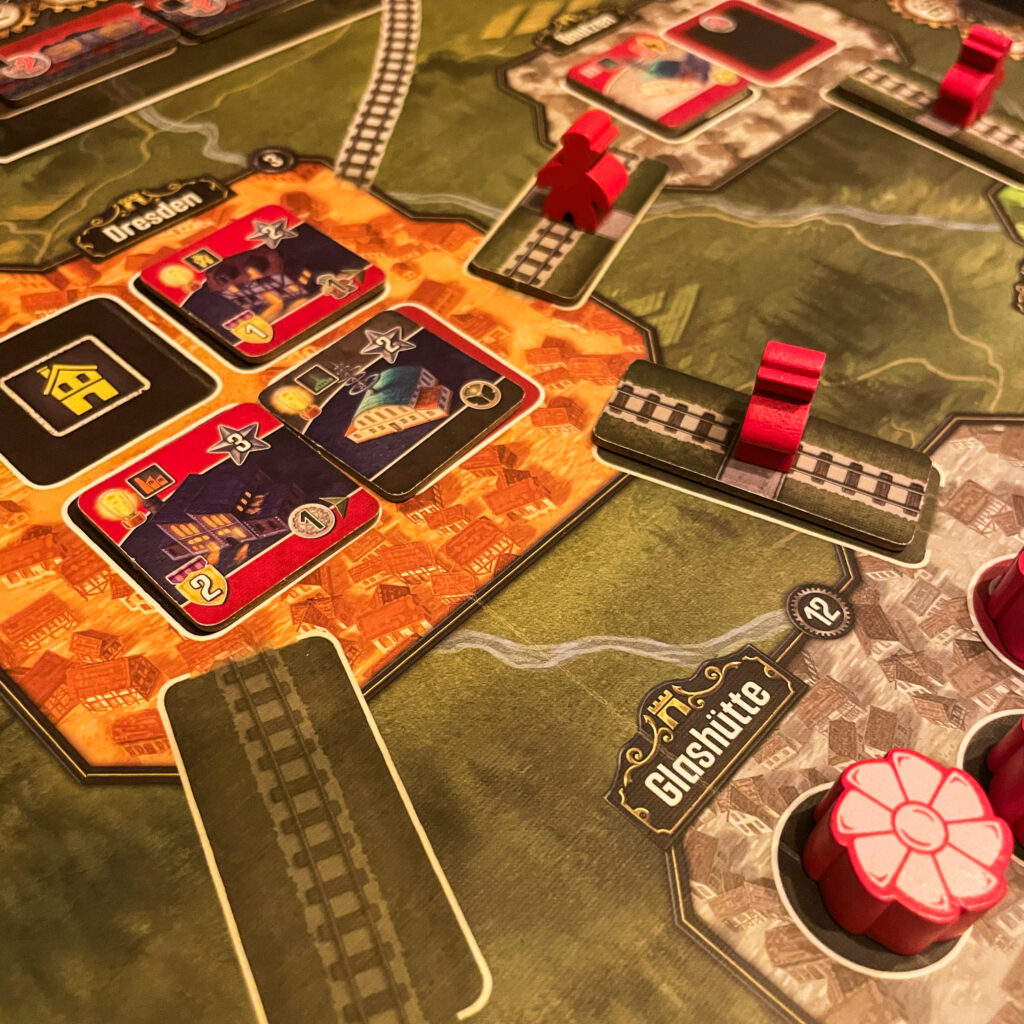
Industrial ambition collides with ruthless efficiency in an alternate 19th-century Saxony where atomic power has arrived a century too early. This is not a game about gentle optimization or forgiving engines; it is a dense, demanding struggle over networks, energy, and timing, where every action carries weight and every misstep echoes for the rest of the game. As players are thrown into a brutal industrial race in which railways are the arteries, power plants are battlegrounds, and electricity is the currency that decides who thrives and who fades into irrelevance.
From the very first turn, the game makes its intentions clear. Resources are tight, opportunities are shared or contested, and progress is never free. Players must carve their influence across the map while simultaneously building an internal engine that can survive the game’s unforgiving rhythm of expansion and recharge.
Nucleum does not hold your hand; instead, it rewards foresight, adaptability, and the courage to commit to long-term strategies in a constantly shifting industrial landscape.

Let’s Play
Begin by placing the main board in the center of the table with the side matching the player count, and position the side board next to it.
Coal Import Wagon tiles are placed on the designated coal production areas with their −1 Thaler side face up, leaving one space empty in each area when playing with three players.
Thaler, Uranium, and Achievement tokens are placed in a common supply, and the VP flag is set at the bottom of the score track.
The Action tiles are prepared by separating the base tiles and shuffling the remaining ones. Depending on the number of players, a specific number of these tiles is added to the base set, divided into three face-down piles, and one pile is used to populate the action market with five face-up tiles.
Contracts are then organized by type. Each player receives one Initial Contract, while only a subset of the Silver and Gold Contracts is used for the game. One Contract of each Purple type is placed face up on the side board, and the Contract market is filled with two Silver and two Gold Contracts.
Next, the Milestone tiles are shuffled and four are placed face up on the Milestone track, along with three Nucleum tokens.
The map is then configured using the Setup cards, which determine the placement of Neutral Urban Buildings, Rubble tiles, additional Nucleum, and blocked spaces. This step defines the early strategic landscape by restricting access to certain cities and construction sites.
After all Setup cards are resolved, unused components are returned to the box, the Endgame Condition markers are placed, and the First Player marker is assigned.
Each player then prepares their personal board. Players take a player board, player aid, a VP token, and starting Thaler, then choose a color and collect all matching components.
Income markers are placed on their starting positions, Urban Buildings are arranged on the player board by level and type, and Mines and Turbines are placed in their designated slots. Workers are split between the player’s supply and reserve, Milestone markers are positioned as instructed, and the Initial Contract is placed on the lowest Contract space without resolving its reward.
Finally, starting with the last player and proceeding counterclockwise, each player selects one Experiment. This choice defines their starting Action tiles, Technology tiles, and Turbine effects. The five Starting Action tiles are placed face up next to the player board, Technologies are arranged on the Experiment board, and any Experiment-specific components are collected. Once this is done, the game is fully set up and ready to begin, with the first player taking the opening turn.

Let’s play
Once the game begins, Nucleum unfolds without rounds or phases. Play proceeds clockwise, with each player taking a single turn at a time until the endgame is triggered.
On a turn, a player must choose one of three options: playing an Action tile on their player board, placing an Action tile onto the map as a railway, or performing a Recharge.
These choices form the core rhythm of the game and define its demanding tempo.
Playing an Action tile on the player board allows a player to resolve the two actions printed on that tile in any order, with the option to skip either one. These actions include building Urban Buildings, constructing Mines and Turbines, acquiring new Action tiles, taking Contracts, or Energizing Buildings.
At any point during this process, the active player may also fulfill one Contract, provided its requirements are met. Action tiles placed on the player board remain there, gradually limiting future actions, until they are recovered during a Recharge.
Alternatively, a player may place an Action tile onto the map as a railway. Doing so requires committing a Worker and positioning the tile on an empty railway space adjacent to a city or another railway.
The placement may trigger multiple actions through color matching, not only for the active player but potentially for others as well. Completing a rail line can immediately expand networks, unlock transportation routes, and award income bonuses to all players involved. Railways remain on the board permanently, shaping interaction and long-term strategy.
The third option, Recharge, acts as both a reset and a strategic checkpoint. During a Recharge, a player gains income based on the Action tiles stacked on their board, places a Milestone marker on the shared Milestone track, and then discards all collected Achievement tokens. Afterward, all Action tiles are retrieved from the player board, restoring flexibility but advancing the game closer to its conclusion. Recharges are also the primary way to score Milestones and can trigger King’s Day Scoring, rewarding players who are leading in Achievement progress at that moment.

As the game progresses, players expand networks across Saxony, construct Buildings and infrastructure, and convert coal and Uranium into electricity through Energize actions.
Energizing Buildings is central to both immediate gains and endgame scoring, as energized Buildings provide benefits when flipped and victory points at the end of the game.
Technologies, earned mainly through Contracts and Laboratories, gradually reshape how players interact with the systems, introducing powerful one-time effects, ongoing abilities, or long-term scoring goals.
The endgame is triggered when a set number of conditions are met, such as depleting Action tiles or Contracts, all players completing multiple Recharges, a player unlocking all Technologies, or someone reaching seventy victory points. Once triggered, all players finish the round and take one final turn, ensuring a fair conclusion.
Final scoring then takes place. Players score points for Milestones based on their tier and associated conditions, for their ultimate Technology if unlocked, and for all energized Buildings on the map, with those in Praha scoring double. Additional points are awarded for reaching the upper spaces of income tracks and for leftover resources converted into victory points. Any penalties from placing Milestone markers on the zero space are applied last. The player with the highest total victory points is declared the winner, with ties shared.

Final Conclusion & rating
Weight: 4.19/ 5
Replayability: 8
Our rating: 8 out of 10 dices
In the end, Nucleum leaves a powerful impression, not only through its demanding systems but also through its production quality and table presence. The components are robust and visually striking, with thick boards, clear iconography, and a functional graphic design that supports the game’s complexity rather than obscuring it. The industrial artwork reinforces the grim, ambitious tone of the setting, and once players become familiar with the symbols, the game flows with surprising clarity for a title of this weight.
Despite its reputation as a heavy, interaction-driven game, Nucleum plays remarkably well with two players. The tighter map and adjusted setup preserve strategic tension, while allowing for deeper planning and long-term positioning without the constant disruption of multiple opponents. That said, the game truly comes alive with three or four players, where shared railways, contested Energize opportunities, and competition for Contracts and Milestones create a far more volatile and challenging environment. At higher player counts, timing becomes sharper, mistakes are punished more quickly, and every decision feels more exposed.
Comparisons to Brass are inevitable, and while the two games share surface similarities in theme and network-based interaction, Nucleum stands apart. Where Brass emphasizes economic cycles, indirect interaction, and market manipulation, Nucleum is more about action efficiency, tactical timing, and layered systems feeding into one another. It feels more puzzle-driven and less forgiving, with a stronger focus on internal engine management alongside shared infrastructure.
Rather than replacing Brass, Nucleum complements it, offering a heavier, more intricate alternative for players who enjoy high-stakes optimization and long-term planning under constant pressure.
An often overlooked but significant part of the Nucleum experience is how much the Folded Space insert improves usability at the table. Once again, it proves to be a genuine value add rather than a cosmetic upgrade. Setup and teardown are faster, components are clearly separated, and frequently used tokens and tiles remain easily accessible during play. This improved organization has a direct impact on the flow of the game, reducing friction and allowing players to focus on strategic decisions instead of component management.
Nucleum is not a game for casual evenings or new players, but for experienced players looking for a deep, challenging Euro with meaningful interaction, it delivers in full. It demands commitment, rewards mastery, and remains engaging from the opening move to the final score. For those willing to invest the time and effort, it is a formidable and memorable addition to any serious board game collection. We on our hand are still more interested in playing Brass but Nucleum is getting close.
Thanks to Board&Dice for this review copy and the opportunity to write about it..