Summary
👥 a game for 2 to 4 players
⏳ Play time is 60 – 120 minutes
🏢 Publisher is Runner Games

Introduction
Step into the world of Granfondo, where tactics, teamwork, and a healthy dose of guts come together. Lead your cycling team over challenging mountains, fast descents, and treacherous cobblestones. Will you go for a smart slipstream, an all-or-nothing sprint… or will you even play with fire by using doping? In Granfondo, you don’t choose a quiet cycling race.

Let’s get in on the table
In Granfondo, you control a team with three riders, you move these riders by playing cards and the best team with the best overall placements and the most points is the winner of this race.
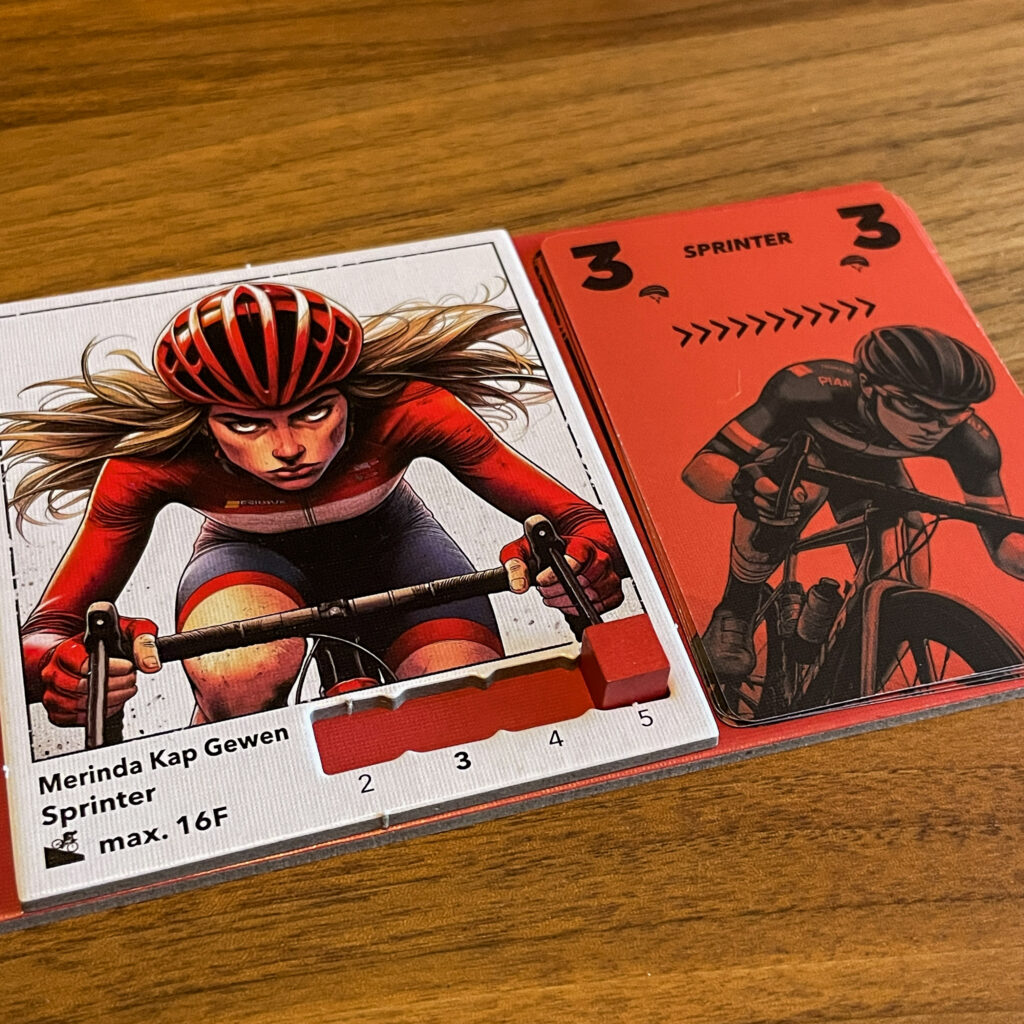
You can start with each track that you want but in your first game its recommended to start with Track C, the beginner and the short race. Before we start, every player receives 3 cyclists (sprinter, climber and all-rounder) in a team color, 3 player boards for the different riders, 20 race cards per rider, 3 performance makers and randomly 3 team members (1 sprinter, 1 climber and 1 all-rounder). Place the performance markers on place 4 (for beginners)
Place to race track in the middle of the table, so every player can reach it. Now shuffle the 20 race cards per rider and create seperate deck for each of your riders.
Shuffle the Fate Cards from 1 to 12 and each player draws fate cards for their riders, these are the starting positions of your riders.

Each round consists of three phases:
- Planning Phase
- Movement Phase
- End Phase
Let’s dive a bit deeper into the different phases
Planning Phase
In this phase you draw cards up to your hand limit and secretly assign one card per rider, in this phase you can also choose to play or discard a doping card.
Movement Phase
In this phase, you reveal your cards and the riders move in order of their position. From round 2 you can also use specials actions like sprint, slipstream, rolling, position battles and Belgian rotation.
End Phase
In this phase you move your played cards onto the discard pile, check your team performance and draw new cards.
The race end when the riders have crossed the finish line, then the placement and doping control follows.

First and Second Round Explained
First Round
Planning Phase
After drawing cards, choose one card for each of your riders and place the selected cards face down.
Movement Phase
In the first turn, riders move in the order of their starting positions. From the second turn onward, the rider in first place moves first. In case of a tie, the rider closest to the inner lane goes first.
Once all players have chosen their cards, reveal them and move x Race Points like you have on the card, move your rider straight forward or diagonally forward. The rider moves a number of spaces equal to the value shown on the card. Riders may move through other riders. If all reachable spaces are occupied, place your rider in one of the spaces directly behind those riders. Then the next rider resolves their movement, and so on.
End Phase
Place all played cards face up on the discard pile of the rider’s tableau. Then draw new cards until that rider’s hand limit is reached.
Second Round and Beyond
From this round on, the key elements of Granfondo come into play:
Rolling
Instead of playing a card, you may move your rider 1 space. If the rider’s Performance value is 2, they gain +1 Performance point instead.
Slipstream
If you end your movement exactly two spaces behind another rider, you may use slipstream to move one additional space forward, ending directly behind that rider.
Sprint
Instead of playing a single card, you can also play multiple cards.
When you are in a sprint and you use 2 cards, you count up the race points and apply a penalty;
for a sprinter -1 Race point
for the other riders -2 Race points
When you are in a sprint and you use 3 cards, you count up the race points and first apply a penalty for 2 cards and then you apply a deduction;
for a sprinter -2 Race points
for the other riders -3 Race points

Doping
Euhm what are you going to explain here? Aren’t we racing fair? No, in Granfondo you have the choice to use doping. Each rider has 2 doping cards, but you have to be aware that you are playing risky and can be disqualified. You play these cards like normal but you can also discard them (nothing happens then). Doping cards also act like wild cards and match the symbols for the teamwork actions.
Teamwork
Like we mentioned earlier, you are also racing with your team. At some points you want to increase your performances. Each racing cards displays one out of six different cycling symbols. To be succesfull at least one of the symbols has to be the same on a card played by each of your 3 riders in the same round. If this condition has been met, you may increase the performance +1 at a rider from your choice.
Course Features
Mountains
Once a rider enters a mountain section or starts their turn on one, their maximum movement per turn is limited:
- Climber: up to 5 spaces
- Rouleur: up to 4 spaces
- Sprinter: up to 3 spaces
If a rider leaves a mountain, this movement limit still applies for the entire turn, as long as the turn started on a mountain.
Obstacles (Dirt & Cobblestones)
When passing through dirt or cobblestones, the rider must make a performance check. Roll the die and compare it to the rider’s current performance value:
- If the roll is higher, nothing happens.
- If the roll is lower, the rider loses 1 performance point.
Outer Curves
If you start your turn on a marked outer curve space, you receive a penalty of -X spaces to your planned movement.
Descents
When you cross a blue descent line, a speed bonus is activated immediately. The size of the bonus depends on the section of the track and is shown on the board.
🥤 Feed Zone
If you end your turn on a feed zone, you gain +1 performance point. Always a welcome boost!

The game ends
When a rider crosses the finish line, the current round is played to completion. During this final sprint, the following actions are not allowed: slipstreaming, battling for positions, and Belgian rotation.
The farther a rider finishes beyond the finish line, the higher their placement. In case of a tie, the rider closest to the inner line takes the better position. Place the riders on the scoring track next to the board. All remaining riders continue the race in the next round.
For the top three finishers, a doping check is now performed. For each of these riders, randomly draw two cards from their played cards. If a doping card is revealed, the rider is immediately disqualified and all of their points are lost. The riders below move up on the scoring track. Any new riders entering the top three must also undergo a doping check.
The team with the highest total score wins the game.

Final Conclusion & rating
Weight: 3.00/ 5
Replayability: 7,5
Our rating: 7,5 out of 10 dices
There aren’t that many board games about cycling, which is exactly why I was so curious about Granfondo. And yes, one of my favorite games in this theme is, not surprisingly, Flamme Rouge. I will probably make a few comparisons here and there, but I’ll try not to overdo it, because while Granfondo shares a similar theme, it definitely feels and plays differently enough to stand on its own.
First of all, you get a double-sided board that offers three different racetracks with varying difficulty levels. The components look great. The cyclist miniatures, the cards, and even the artwork are surprisingly well done. In Granfondo, you control three different riders, which means you start with quite a large hand of cards. That takes a bit of getting used to. What I really like is that the number of cards per rider can vary, and this can even change during the game, which adds another layer of tactical depth.
Granfondo is a tactical racing game full of interaction, tension, and memorable moments. It’s perfect for players who enjoy planning ahead, taking bold risks, and racing toward photo finishes. That said, we did feel the rulebook could have been a bit clearer. It sometimes lacked detailed explanations and example images of situations on the board, which would have helped during the first plays.
You can start and play the game in different ways, for example with a shorter introductory race before moving on to the full, more advanced version. The board system, with three races across two double-sided boards, works well. It’s a different approach compared to modular track systems like in Flamme Rouge, but both methods work perfectly fine. You see a similar fixed-board approach in Heat as well.
It would be even more exciting if future expansions introduced additional race routes with new challenges. Maybe wind conditions or cobblestone sections? That would add even more variety. We do feel that Flamme Rouge is slightly more suitable for family play, while Granfondo leans a bit more toward the strategic side. Still, overall, we genuinely enjoyed our time with the game.
We want to thank Runner Games for this review copy and the opportunity to write about this game.