
Summary
👥 A game for 2 players
⏳ Play time is 45 minutes
🏢 Publisher is Synapses Games

Introduction
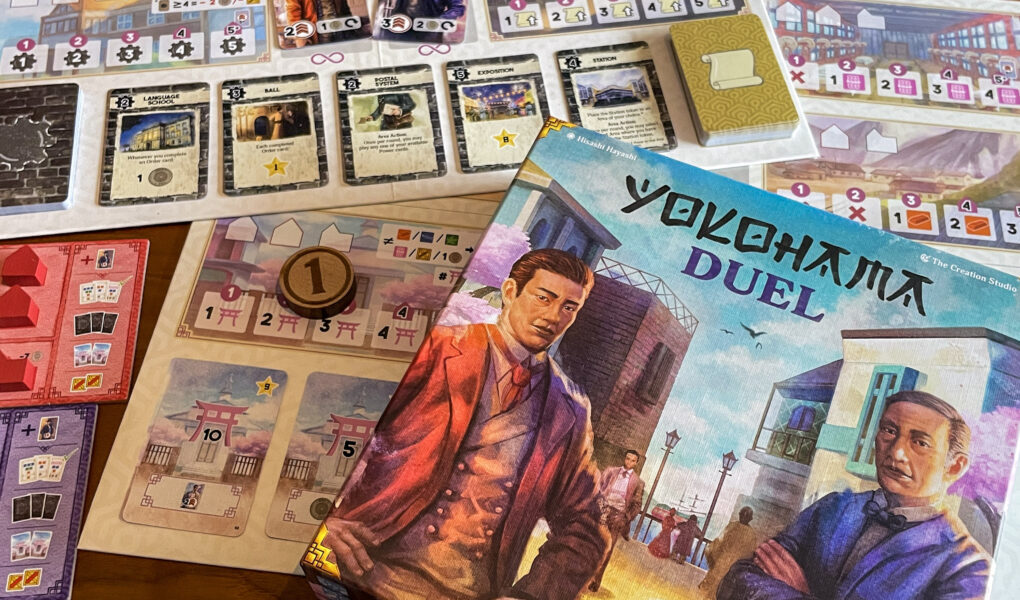
Set during Japan’s transformative Meiji era, Yokohama takes players to a city rapidly opening itself to the world. Once a quiet fishing village, it has become a thriving hub of international trade, innovation, and cultural exchange.
As ambitious merchants, players compete for prestige by deploying assistants, building shops and trading houses, embracing new technologies, and fulfilling valuable orders. Yokohama Duel blends smart economic planning with tactical movement, capturing the tension of a city racing toward modernity.

Let’s get in on the table
Place the two main game boards in the center of the table, either side by side or one above the other, depending on the available space.
Shuffle the Power Bonus cards, place three of them face up on their designated spaces, and form a face-down draw pile with the remaining cards. Place the Extra Power cards next to the board as two separate face-up decks, one for +1 Power and one for +2 Power.
The Foreign Agent cards are placed face up on their space, while the Technology cards are shuffled and five are revealed face up, with the rest forming a face-down deck.
Shuffle the Order cards and place them face down on the board. Shuffle the Church cards, reveal six of them face up, and return the remaining three to the box.
All trade goods, imported goods, money tokens, and the Station token are placed next to the boards to form a general supply.
Each player chooses a color and receives a player board, four Power cards placed with their “before upgrade” side face up, eight Shops, and four Trading Houses, which are placed on the corresponding spaces on the player board.
Each player also starts with one Copper, one Silk, one Tea, and one Fish.
Determine the starting player; the most recent person to have visited a port takes the first turn. The starting player receives three yen and one +1 Extra Power card, while the second player receives four yen and two +1 Extra Power cards.
Finally, each player draws three Order cards, keeps two of their choice, and places the remaining card at the bottom of the deck. Set the scoring pad aside, as it is only used at the end of the game.
The city of Yokohama is now ready for trade, expansion, and competition
Let’s play
A game of Yokohama duel is played over four rounds, with each round consisting of four turns per player. Players alternate turns, starting with the designated starting player for that round. The starting player alternates each round, ensuring both players have equal opportunities to act first.
After the fourth round, the game ends immediately and final scoring begins.
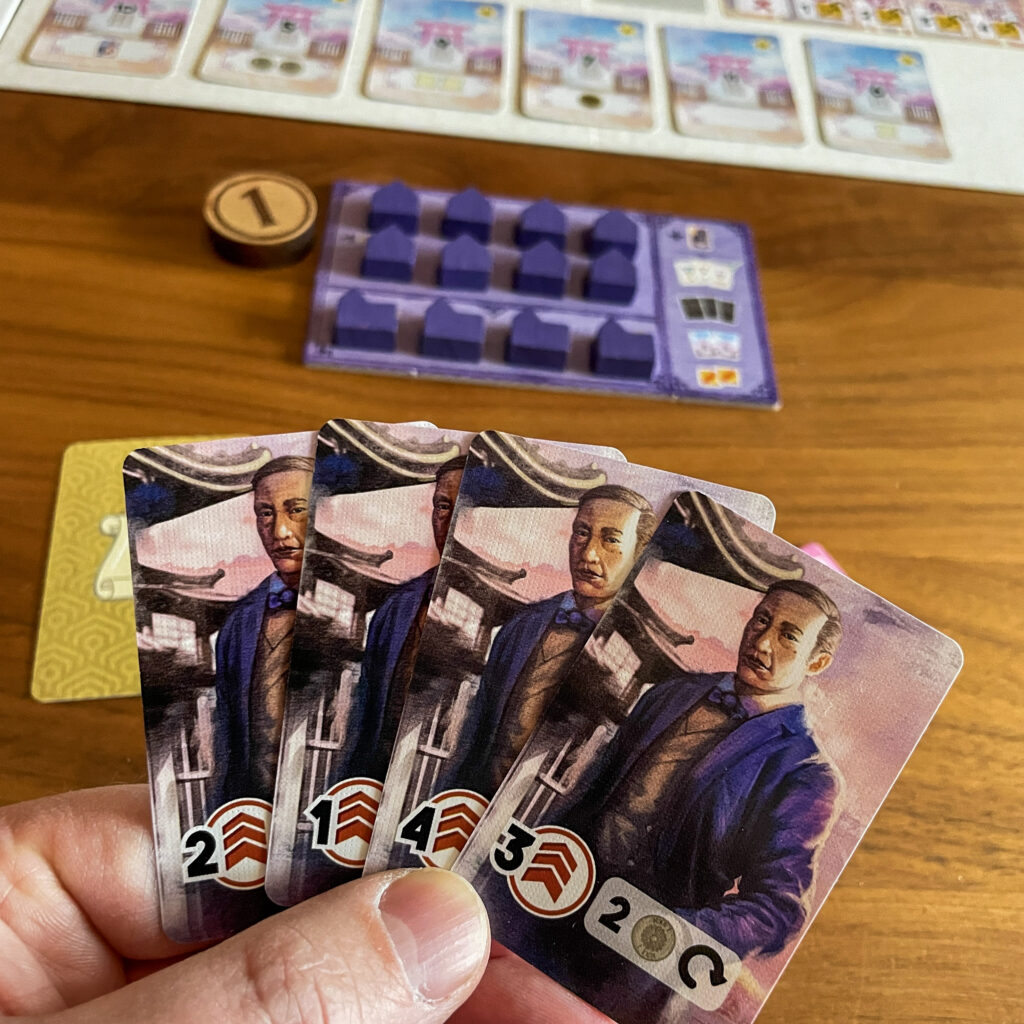
On a player’s turn, the game always follows the same structure. First, the player performs an Area Action by choosing one area on either game board. An area may not be chosen if it has already been used during the current round, meaning a Power card has been placed there earlier, with the exception of the Laboratory and the Port, which are always available. To activate an area, the player must play one of their Power cards, following the Power Card Order rule, which requires them to play the lowest-value Power card they currently have available. Optionally, the player may add one Extra Power card to increase their total Power for that action.
The strength of the chosen area’s effect depends on the player’s total Power, which is calculated by combining the Power card played, any Extra Power used, bonuses from Shops or Trading Houses built in that area, applicable Technology card effects, and the Station token if it is present. The opponent’s buildings or Power cards never contribute to this total. After calculating Power, the player resolves the effect of the selected area, such as gaining trade goods, money, Technology cards, Order cards, or interacting with Imported Goods or Church cards. If either player has a Trading House in the selected area, that player immediately gains one yen from the supply.
If the total Power used for the Area Action is five or more, the player may then perform the 5-Power Bonus step. The player selects one face-up Power Bonus card and receives rewards based on their total Power, gaining the first reward at Power five, additional rewards at Power six, and all listed rewards at Power seven or higher. The chosen Power Bonus card is discarded and replaced with a new one from the deck.
After this, if the player’s total Power during the Area Action was at least four, they may optionally construct either a Shop or a Trading House in the selected area. A Shop costs one yen and may only be built if the player does not already have a Shop in that area. A Trading House may only be built if neither player has one there yet, and its cost increases with each Trading House the player builds over the course of the game. Construction enhances future actions by increasing Power in that area and, in the case of Trading Houses, generating income whenever the area is used.
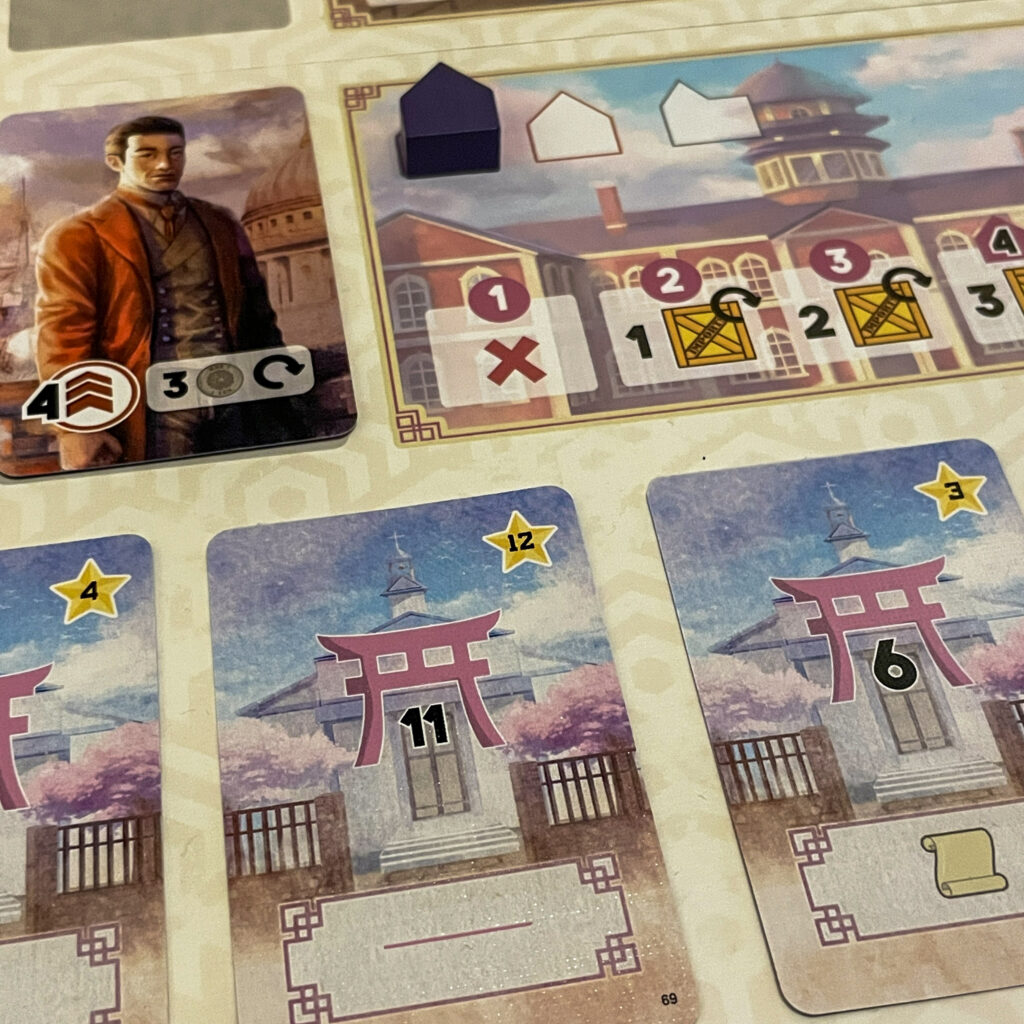
In addition to these steps, players may perform several free actions at any time during their turn. Players may complete Order cards from their hand by paying the required trade goods and immediately receiving the listed rewards. They may hire Foreign Agents once they meet specific development milestones, such as completing Orders, acquiring Technologies, gaining Church cards, or flipping Imported Goods. A hired Foreign Agent can later be used as a special Area Action, functioning like a Power card with a base value of three and allowing the player to select even areas that are already used. Players may also activate the effects of their Technology cards, some of which provide ongoing bonuses while others can be used once per round.
At the end of rounds one through three, players prepare for the next round by reclaiming all Power cards played during the round. At this time, each player may upgrade one of their Power cards by paying the indicated cost, permanently increasing its strength for the rest of the game. Any Technology cards that were used during the round are refreshed, and any unclaimed face-up Technology cards are discarded and replaced with five new ones. The player who took the last turn in the round becomes the starting player for the next round. After round four, this upkeep phase is skipped and the game proceeds directly to scoring.

The game ends
Final scoring takes place in a fixed order.
Players score points for their completed Order cards, followed by a bonus awarded to the player who completed the most Orders. Technology cards are then scored according to their individual conditions, after which a Technology bonus is awarded to the player with the highest total Production value. Church cards are revealed and scored, followed by points for Trading Houses and Shops built. Players then score points for face-down and face-up Imported Goods, convert remaining money into points at a rate of one point per two yen, and finally gain points for leftover trade goods at a rate of one point per three goods, regardless of type.
The player with the highest total score wins the game. In the event of a tie, players compare their scores category by category in the order they were scored, starting with completed Orders, until the tie is broken. If all categories are tied, the victory is shared. Yokohama duel rewards careful planning, tactical timing, and efficient use of limited actions, offering a tightly balanced contest of economic growth and strategic positioning.

Conclusion & our score
Difficulty: 2.65/ 5
Re-playability: 7
Our score: 6 out of 10 dice
Yokohama Duel is a polished and thoughtfully designed game that successfully translates the spirit of the original into a dedicated two-player experience. The production quality is excellent: the graphic design is clean, readable, and elegant, and the visual style fits the Meiji-era theme perfectly without overwhelming the table. Everything feels deliberate and carefully crafted, from the iconography to the board layout.
That said, while this Duel version plays smoothly and offers a well-balanced head-to-head experience, our preference still leans toward the original Yokohama. The full game simply offers more room for variation and creativity, even when played with two players. Each session feels slightly different, with more freedom to shape your strategy and develop the city in unique ways. By comparison, Yokohama Duel is tighter and more controlled, which will certainly appeal to players looking for a focused and streamlined experience, but it leaves less space for emergent variety.
Ultimately, Yokohama Duel is a strong and elegant game in its own right, especially for players seeking a competitive, strategic two-player title. However, for those who value replayability through broader strategic possibilities and a more open-ended development of the game state, the original Yokohama remains the more compelling choice.
We want to thank Synapses Games for this review copy and the opportunity to write about it.