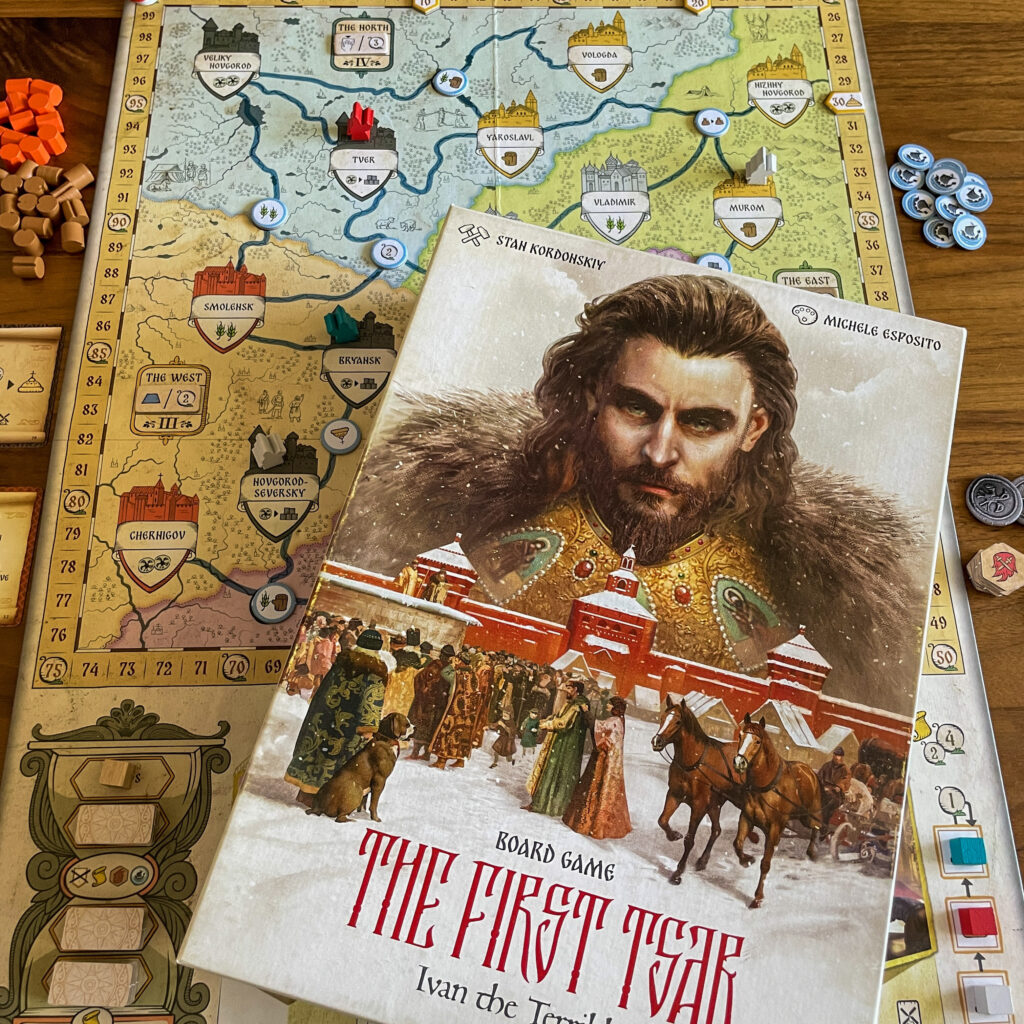
Summary
👥 A game for 2 – 4 players
⏳ Play time is 90 – 120 minutes
🏢 Publisher is Hobby World

Introduction
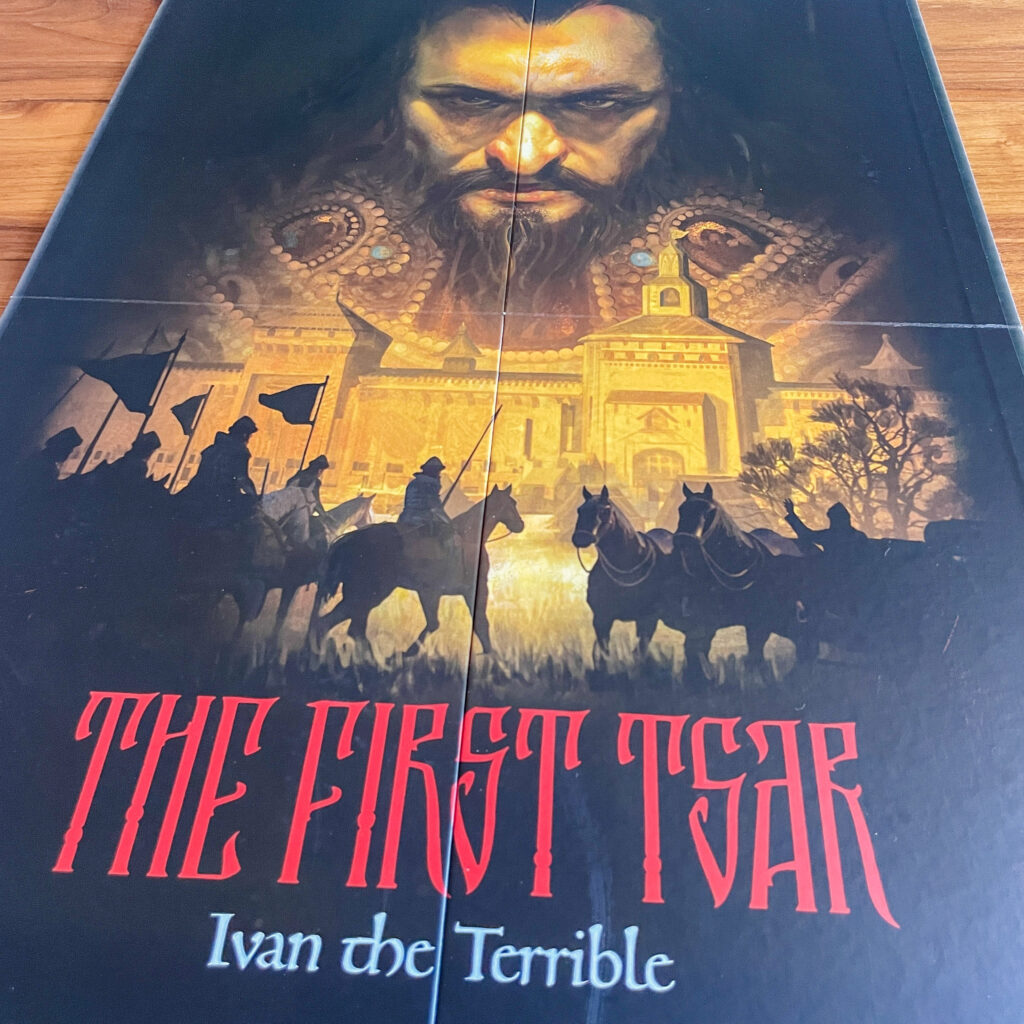
In the winter mists of 16th-century Russia, a child crowned himself sovereign over a fragmented land and by the time he was done, he had carved a Tsardom in blood and fire. The First Tsar: Ivan the Terrible invites players into a grim and gripping chapter of history, when fear ruled from the Kremlin and ambition could be as dangerous as treason.
As one of the great boyars, military commanders, or rising powers in Muscovy, you are thrust into the chaos and cruelty of Ivan IV’s reign. This is not merely a game of politics or war it is a battle for survival in a land where power is both a blessing and a curse. Ivan, the first to bear the title of Tsar, is both protector and predator. His infamous Oprichnina part secret police, part personal army scours the land for enemies real or imagined, and even the most loyal servant may find themselves suddenly condemned.
The game brilliantly captures this paranoia and ambition. Every decision feels weighty, every alliance uncertain. You’ll build influence in the court, strengthen your military foothold, and attempt to shape the future of Russia if you can keep your head long enough to see it. Rich in historical detail and unrelenting in atmosphere, The First Tsar doesn’t just ask you to play in the past it forces you to reckon with it.
In this game, history is not just background, it’s the blade at your back.
Let’s get in on the table
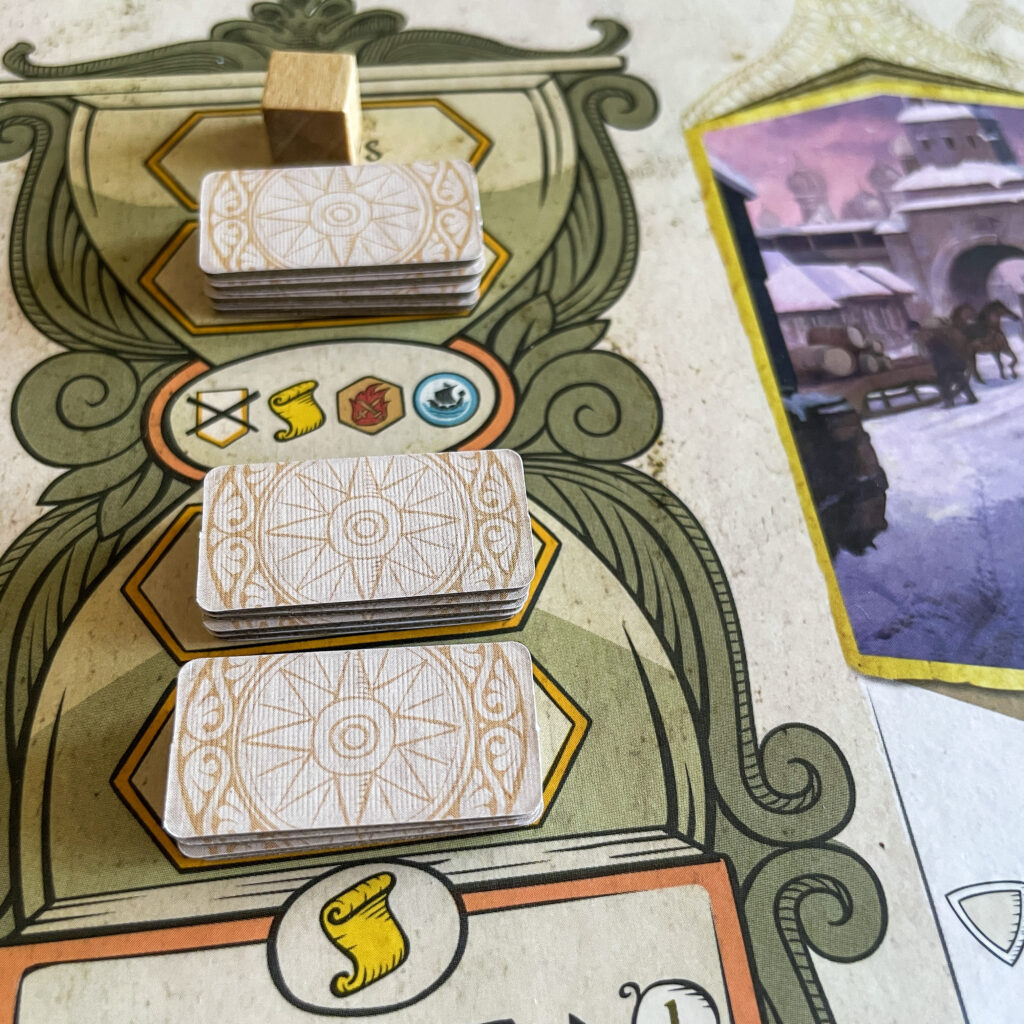
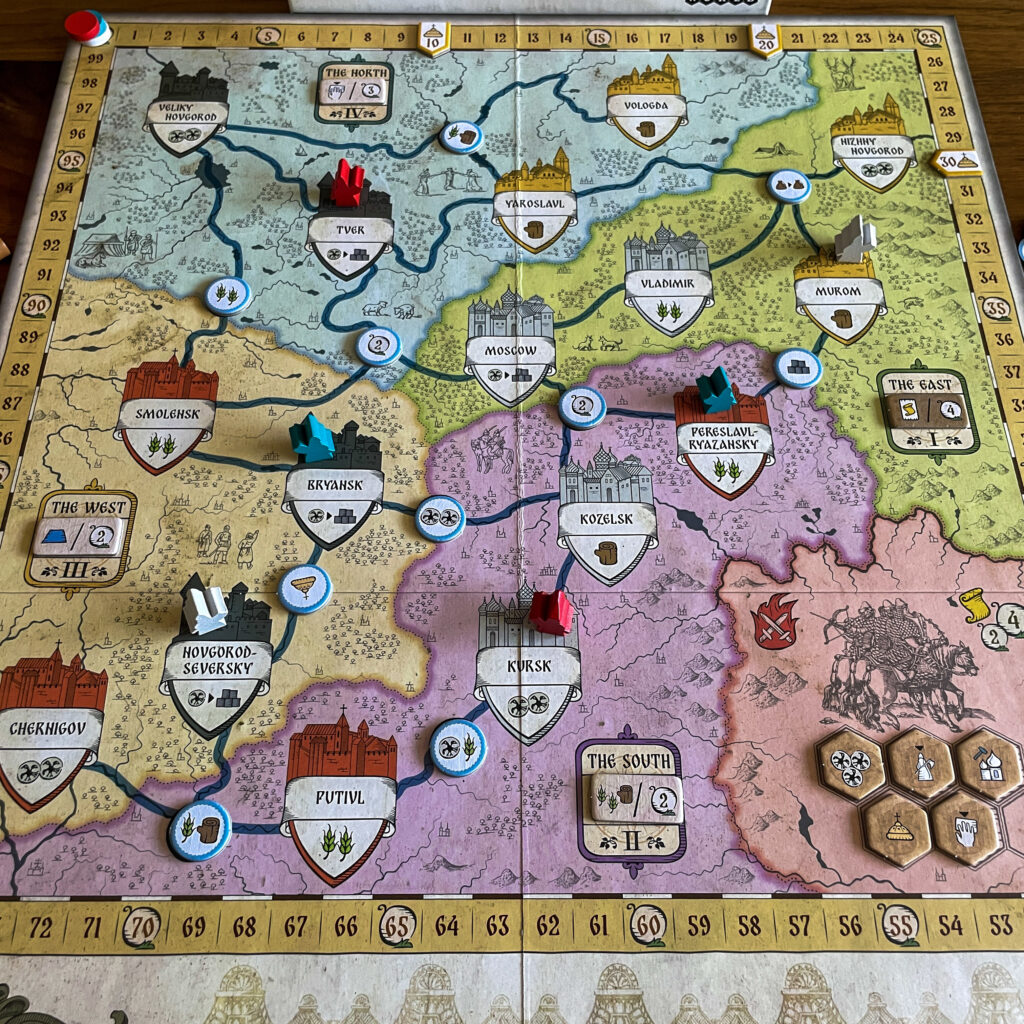
Begin by laying the game board at the center of the table. Place the Tsar’s Favor tokens on the victory point track at the 10, 20, and 30 spaces.
Shuffle the six Assignment cards and lay five face up beneath the Kremlin Chambers, one for each chamber, while placing the remaining card face down nearby.
Next, organize the general supply: group all Goods tokens and Coin tokens into accessible piles beside the board.
Position the round marker at the start of the timeline, in the 1550s.
Sort the Region tokens into those with light and dark backgrounds. Place four dark-backed tokens face down on the 1580s decade space. Then, for each of the remaining decades, stack four mixed tokens face down.
Finally, place four light tokens face up directly onto their corresponding provinces on the game map.
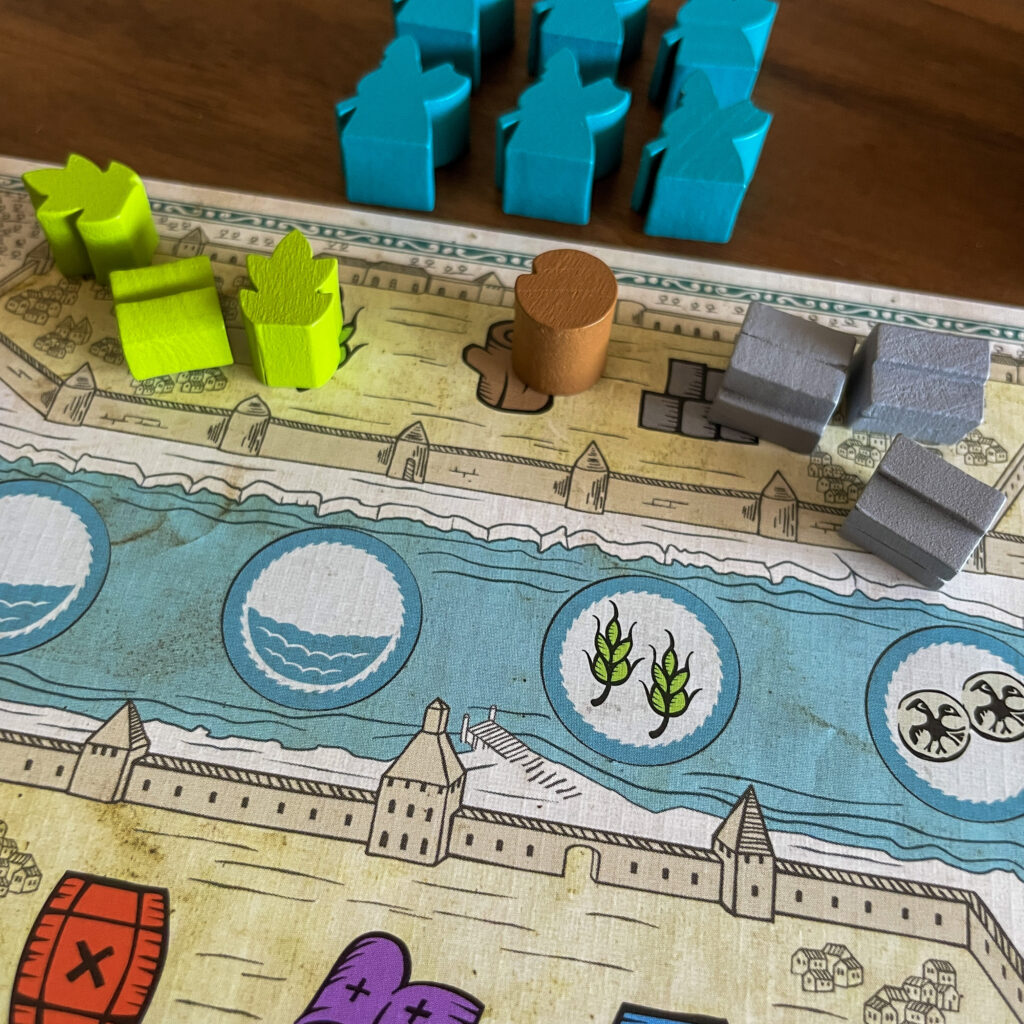
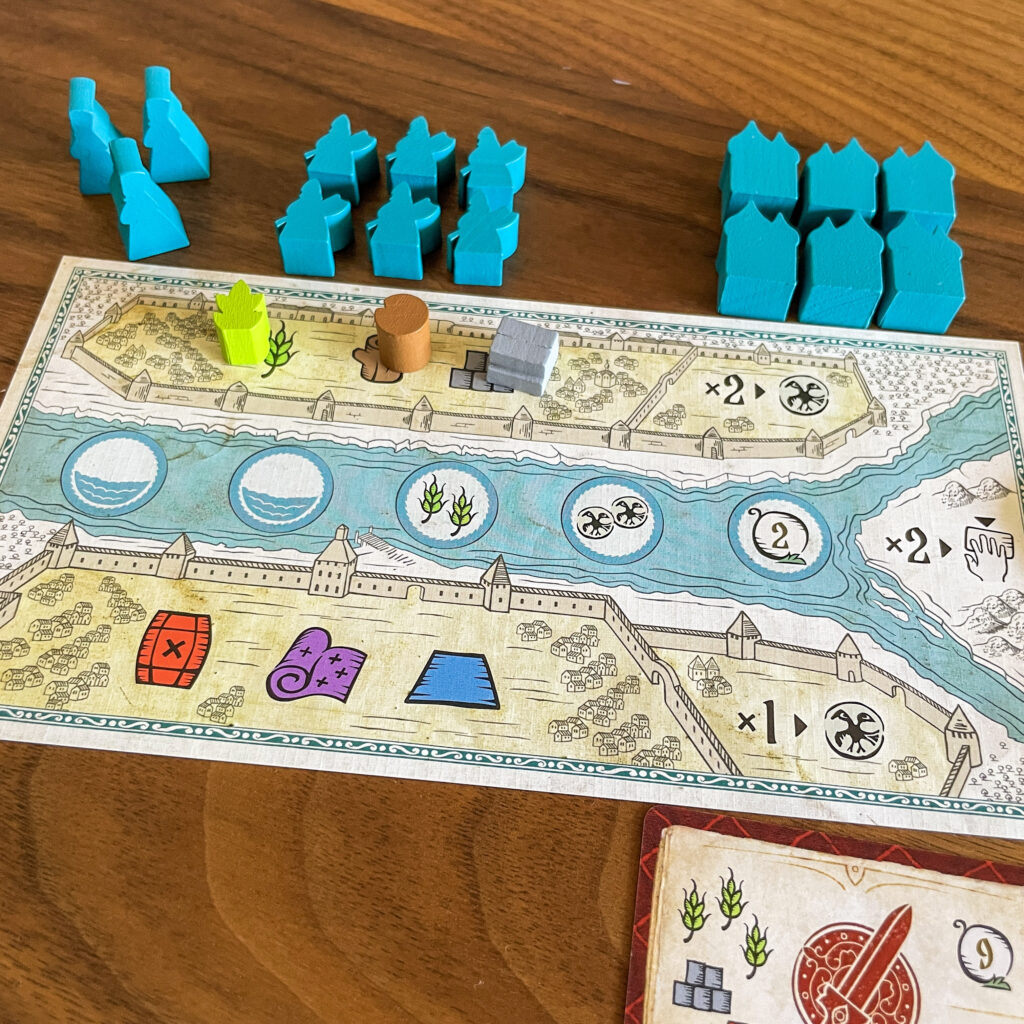
Shuffle the Spoils tokens and, depending on the number of players, draw a specific number and place them face up in the Field of War area. The remaining Spoils tokens remain face down and off the board. Do the same with the Trade tokens, shuffle them and place ten face up into the river spaces on the map, setting the rest aside face down for later use.
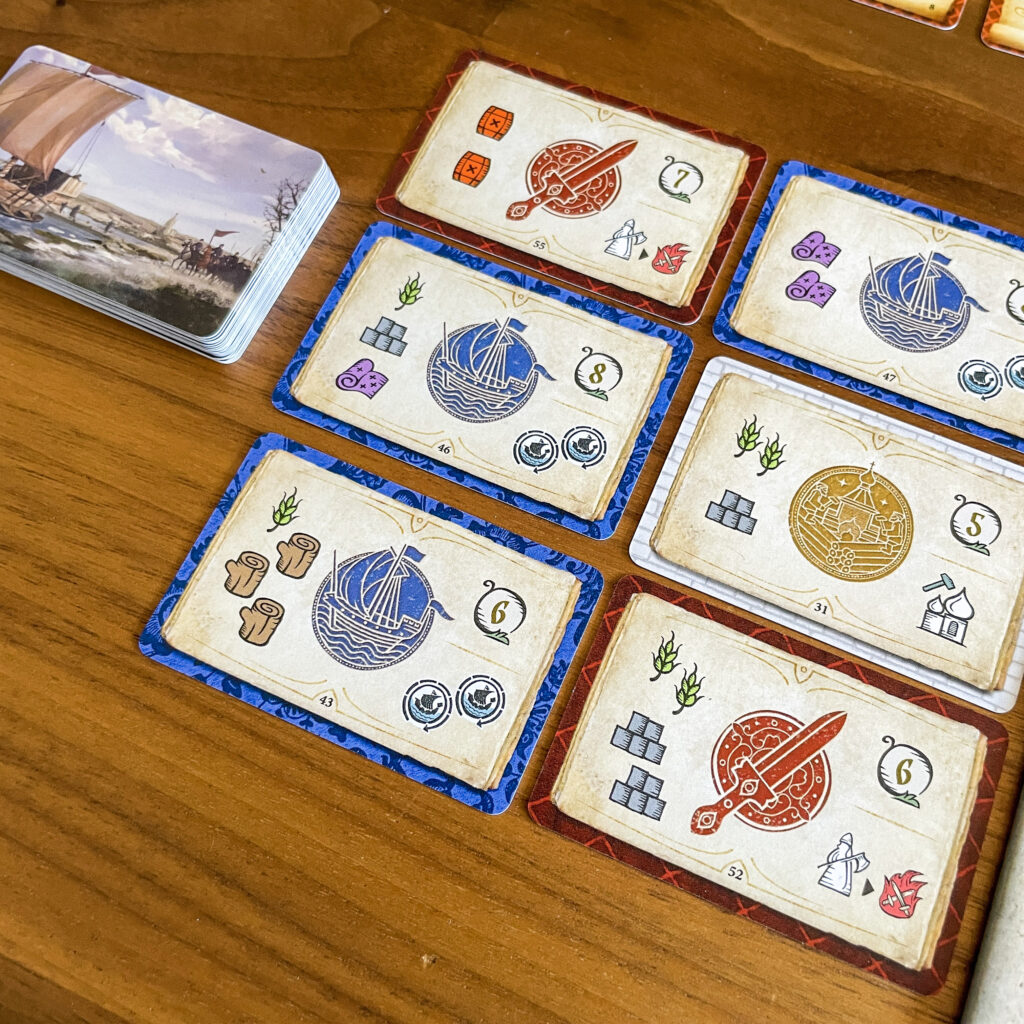
Shuffle the Title and Estate decks separately and reveal three cards from each deck near the board to form the initial draft pools. In a two-player game, reveal only two of each. Keep both decks nearby to replenish during the game. Shuffle the Project deck, then deal three cards to each player. Every player keeps one project and returns the other two to the deck, which is reshuffled. Then draw six Project cards from the deck and display them face up beside the board.
Each player chooses a color and takes their player pad, along with all matching pieces: three Boyars, six Buildings, ten Warriors, two Seal tokens, and markers for Victory Points and Tsar’s Favor.
Place each player’s Victory Point marker at zero on the track. Then place their Tsar’s Favor marker randomly on the Favor track from top to bottom, skipping any empty spaces.
Every player begins with one Grain, one Wood, one Stone, and three Coins from the supply.
Determine the starting player by locating the player with the lowest-positioned Favor marker on the Favor track.
The player to their left becomes the first player and takes the First Player token. With the board prepared, the Kremlin chambers assigned, and players seated with their starting resources and objectives, the game is ready to begin.
Muscovy stands divided, the Oprichniki are watching, and the throne casts a long and dangerous shadow.
Let the age of the First Tsar begin.
Let’s play
The First Tsar: Ivan the Terrible unfolds across four rounds, each representing a decade in Ivan IV’s reign from the 1550s through the 1580s.
As rival boyar families in a violent and unpredictable Russia, players must navigate the Tsar’s ambitions, the chaos of war, and the treachery of court politics to build lasting influence.
The game is structured into a steady rhythm of planning, action, and resolution, with each round layering more complexity as players compete for control, resources, and ultimately, favor.
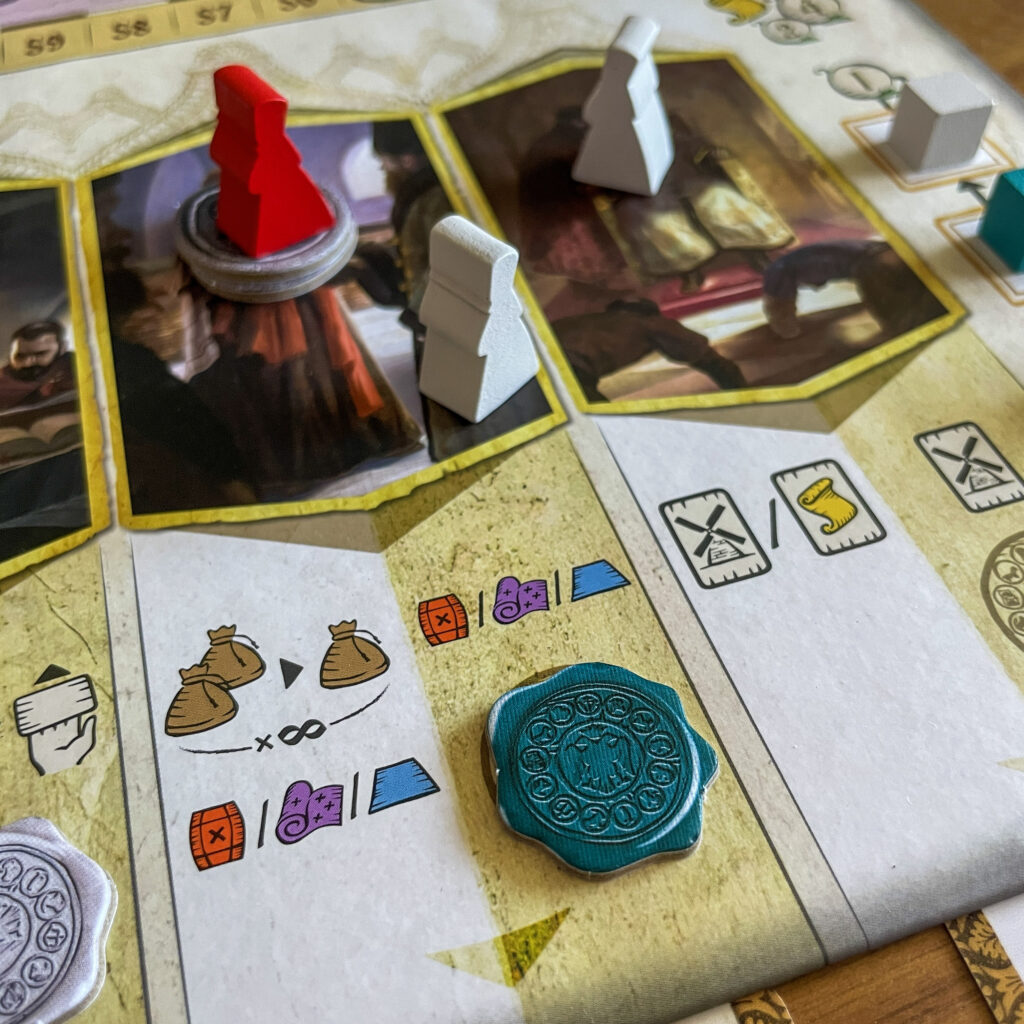
Each round begins with the Planning Phase. Players take turns assigning their three boyars representatives of their power base into five Kremlin chambers. Each chamber offers two distinct actions: one accessible to everyone, and one available only to the player who wins the chamber by offering the highest bribe in coins. Bribing too often is risky, as players can only activate these bonus actions twice per round by placing one of their limited seals in the chamber. The Tsar’s Favor track plays a critical role in this phase, breaking ties and determining the order in which players resolve their placements.
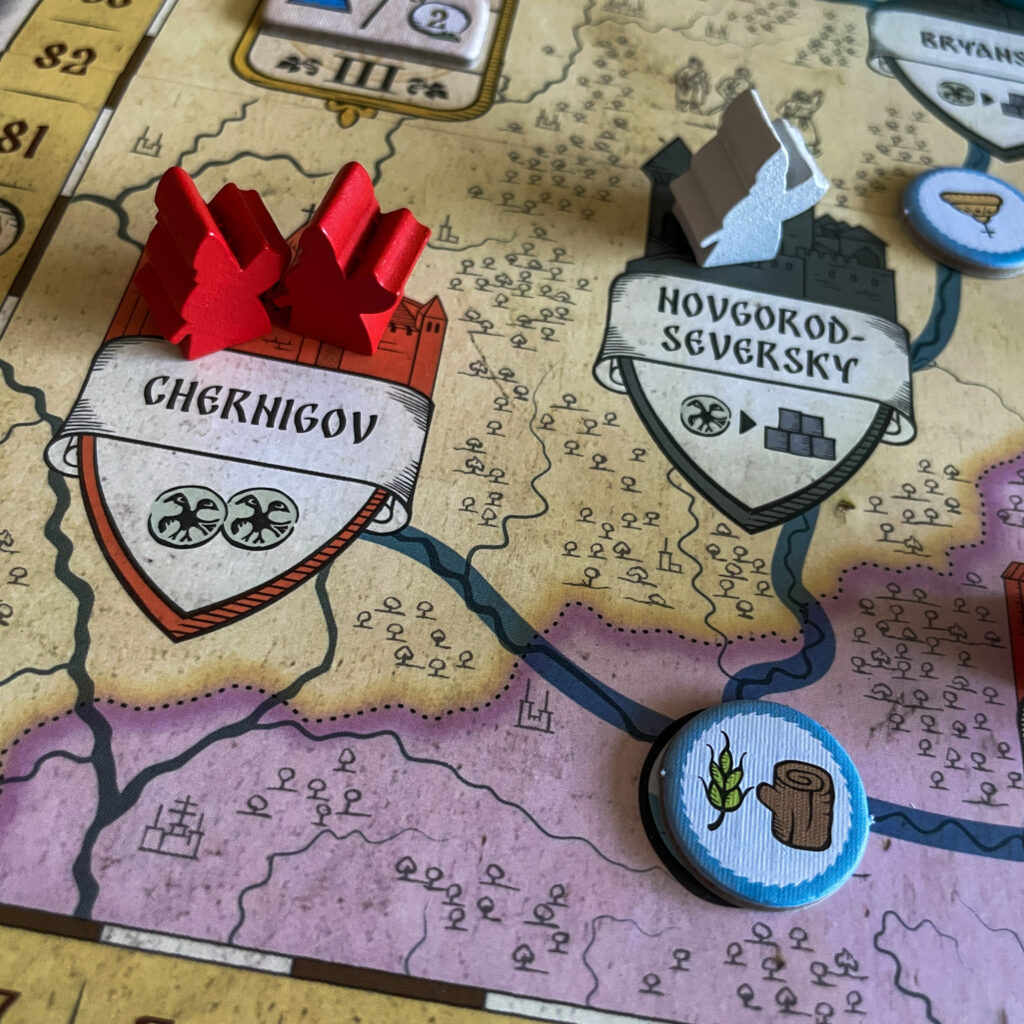
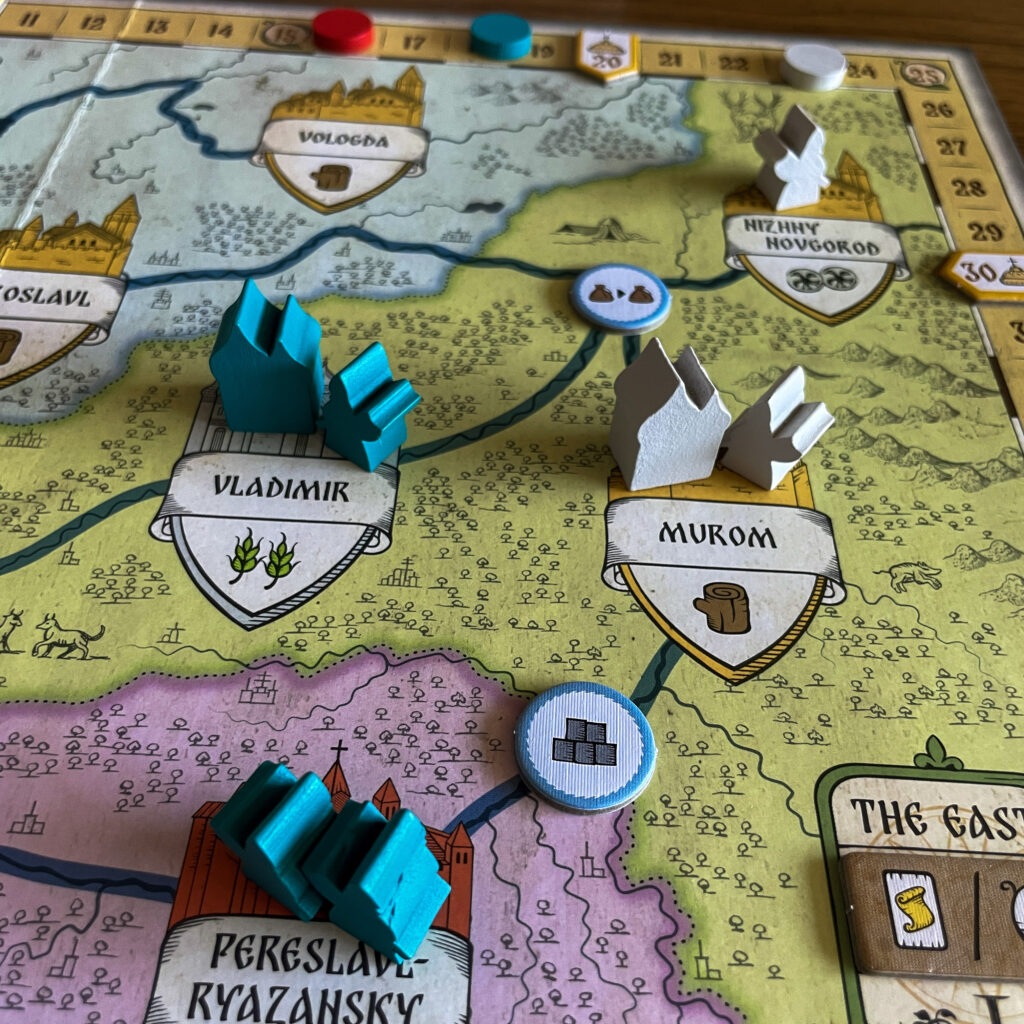
After all boyars are placed, the game proceeds to the Action Phase. Starting with the first player, determined by who stands lowest on the Favor track, each player resolves their boyars one at a time. They perform the action of the chamber they placed in harvesting resources, deploying warriors, claiming estates, drafting title cards, or investing in projects. If they won the chamber’s bid, they also perform a powerful secondary effect and place a seal, which may bring future benefits or help complete certain scoring goals. After acting, the boyar moves to a city on the map that corresponds to the chamber’s current assignment, further influencing the board and preparing the player for regional scoring.
When all boyars have acted, the Cleanup and Scoring Phase begins. First, players evaluate control over the four main regions of Russia Muscovy, the Volga, the Baltic, and the Horde. Control is determined by a mix of warriors and buildings in each region, and the leading players earn immediate victory points. After the second and fourth rounds, bonus scoring also takes place: players with the most influence in the Tsar’s Favor and those most committed to military campaigns gain additional rewards.
Then, the game resets for the next decade.
Assignment cards are reshuffled, chamber placements are cleared, and new region tokens and project cards are introduced, reflecting the passage of time and the shifting political landscape.
Over the course of these four decades, players build their power in multiple ways. They collect and manage resources grain, wood, and stone to complete projects and sustain their plans. They recruit warriors and place them into contested regions or send them to fight in distant wars. Titles and estates provide prestige and endgame points, while project cards offer both immediate advantages and long-term benefits. All of these paths are interwoven, and success depends on knowing when to invest in military strength, when to bend the knee to the Tsar, and when to turn to commerce, land, or legacy.
The Game Ends
At the end of the fourth round, the final scoring phase begins. Players tally their accumulated victory points from regional control, completed projects, held titles and estates, and their final standing on the Tsar’s Favor track. Additional points come from leftover resources and certain bonuses achieved during the game. The player with the highest total score is declared the most powerful boyar in Russia an enduring figure in the age of the First Tsar, haring not only survived but thrived under one of history’s most infamous rulers.
Conclusion & end score
Difficulty: 3.10/ 5
Re-playability: 7
Our score: 7 out of 10 dice
The First Tsar: Ivan the Terrible delivers a tightly woven experience set against one of history’s most ominous reigns. It offers a satisfying level of strategic depth without tipping into overwhelming complexity, making it well-suited for players who enjoy planning, positional play, and long-term decision-making.
The components are sturdy and well-designed. The board is detailed and thematic, while the tokens and cards are clear and durable. Nothing flashy, but everything feels solid and fits the game’s serious tone perfectly. The game’s limited number of rounds keeps the pressure high, while the ever-shifting dynamics of the Kremlin, regional control, and the Tsar’s unpredictable favor ensure that no two games feel quite the same.
There’s a certain weight to each choice whether to bribe for an advantage, send troops to distant wars, or invest in estates that may or may not pay off by the end. Its mechanics reflect its theme with impressive clarity: power is always fleeting, and ambition comes at a cost. While it may not revolutionize the genre, it stands as a thoughtful, engaging, and often tense journey through the politics and paranoia of Ivan’s Russia. It’s a game that earns respect for its historical flavor and the way it demands both restraint and boldness.
The game plays best with three players. It offers the ideal balance of tension, interaction, and pace tight enough to keep decisions meaningful without dragging. At four, the game is more intense but slower; at two, it’s sharper and faster, but loses some of the intrigue. For the most engaging and well-rounded experience, three is the sweet spot.
A compelling strategy game with a strong identity one that invites players back for more, even if the Tsar never truly forgives.
Thanks to Hobby World for this review copy and the opportunity to write about this game.