Summary
👥 A game for 2 – 4 players
⏳ Play time is 30 – 45 minutes
🏢 Publisher is Lautapelit.fi

Introduction
The race has begun, each team has used cunning and skill to position their sprinter for the moment but only one team has done enough to win.
Will your team ride up front or will you play it safe from the middle of the pack and instead want to surprise everyone by striking from behind?
Anyone can race, but few become champions! Will your team win this legendary cycling race?
Let’s get in on the table
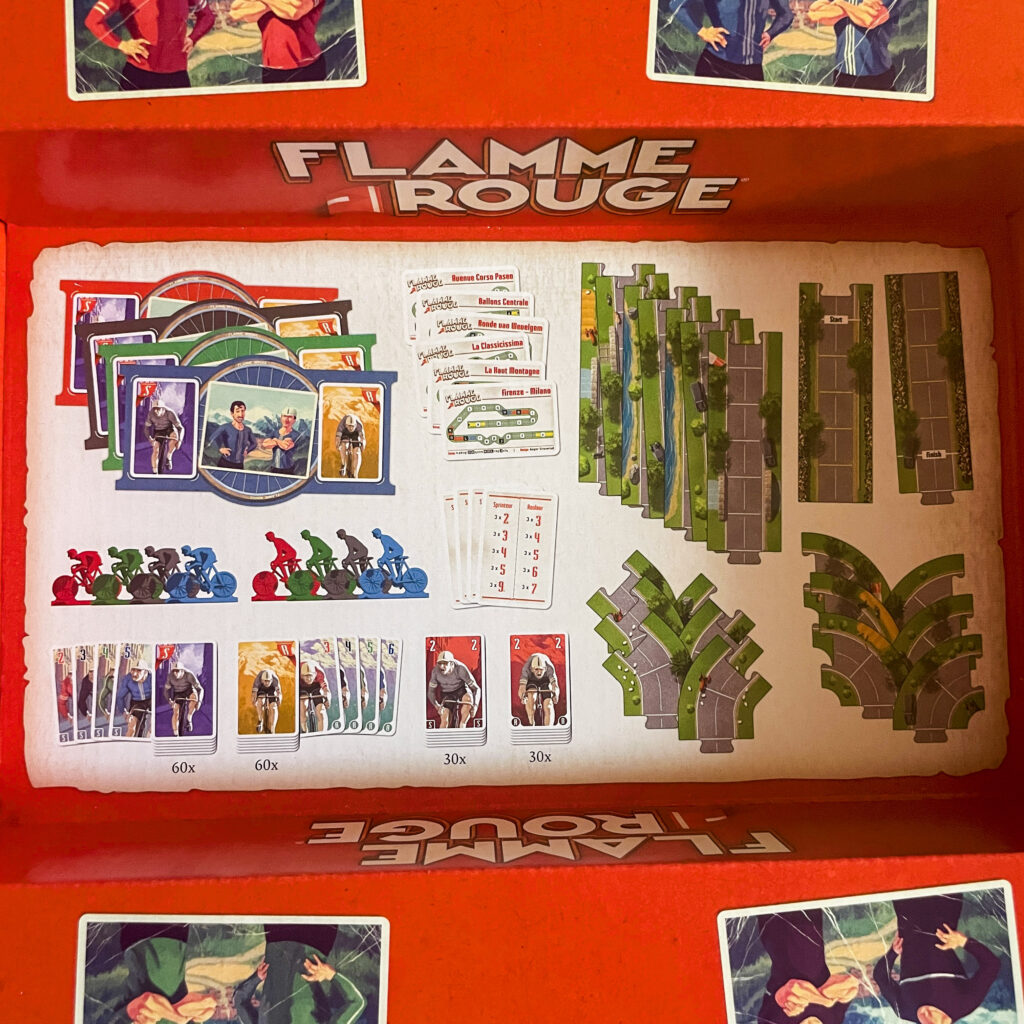
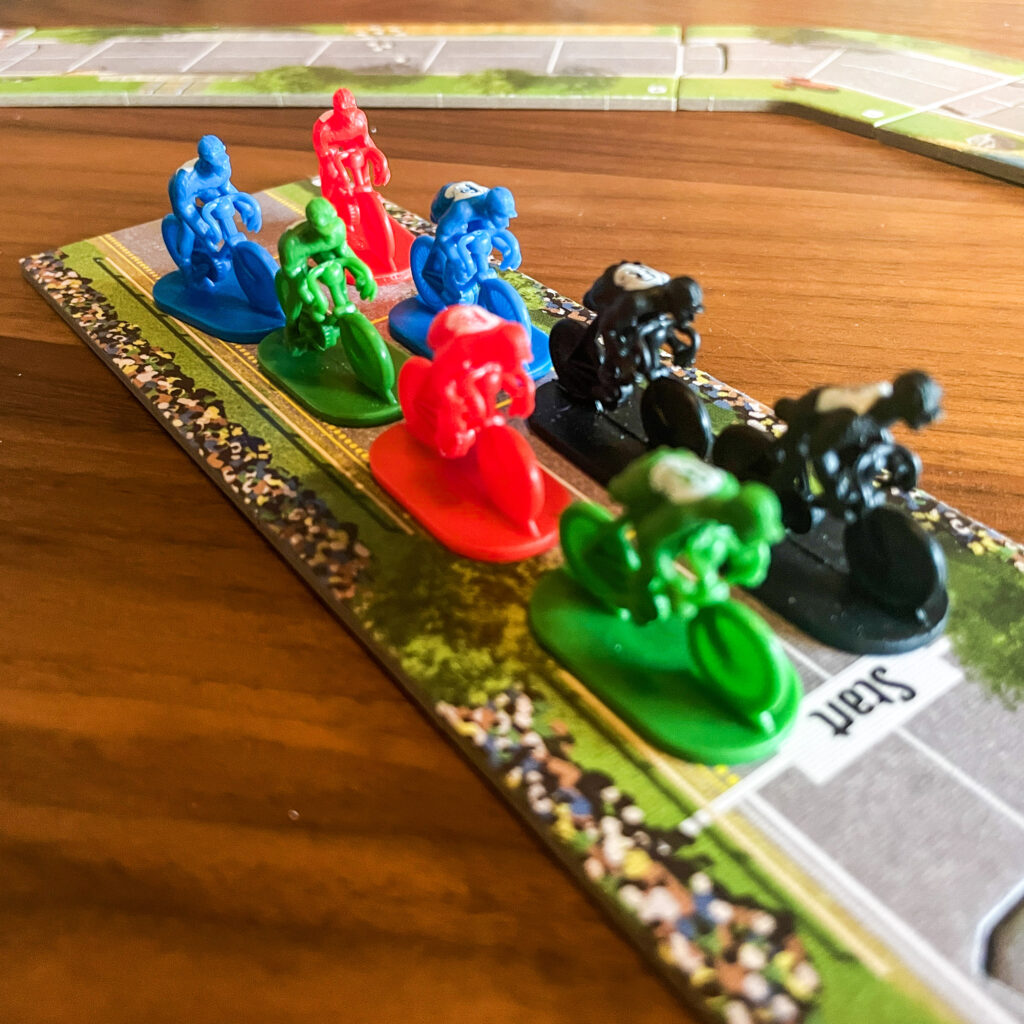
Choose a stage card and build the track with the tiles depicted on it. For your first game: Use the stage card Avenue Corso Paseo. For all tiles, use the sides with lowercase letters (abc…).
Choose a colour and take a sprinteur and a rouleur and their matching energy cards including a player board of your colour.
Shuffle your sprinter and rouleur’s energy cards into their own pile of cards and place them on your player board face down on the designated space.
Form depletion piles and place all of the sprinters’ and rouleurs’ depletion cards face-up within easy reach of all players.
Let’s play
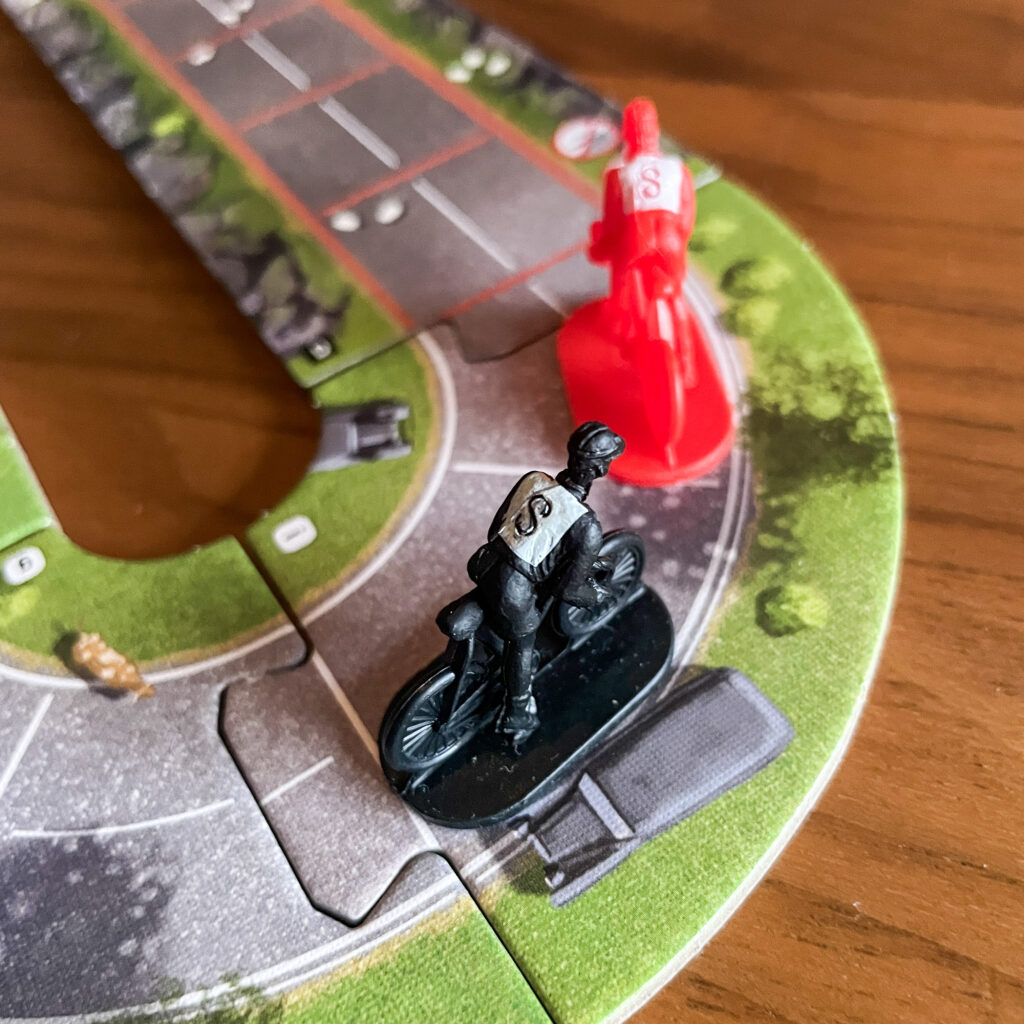
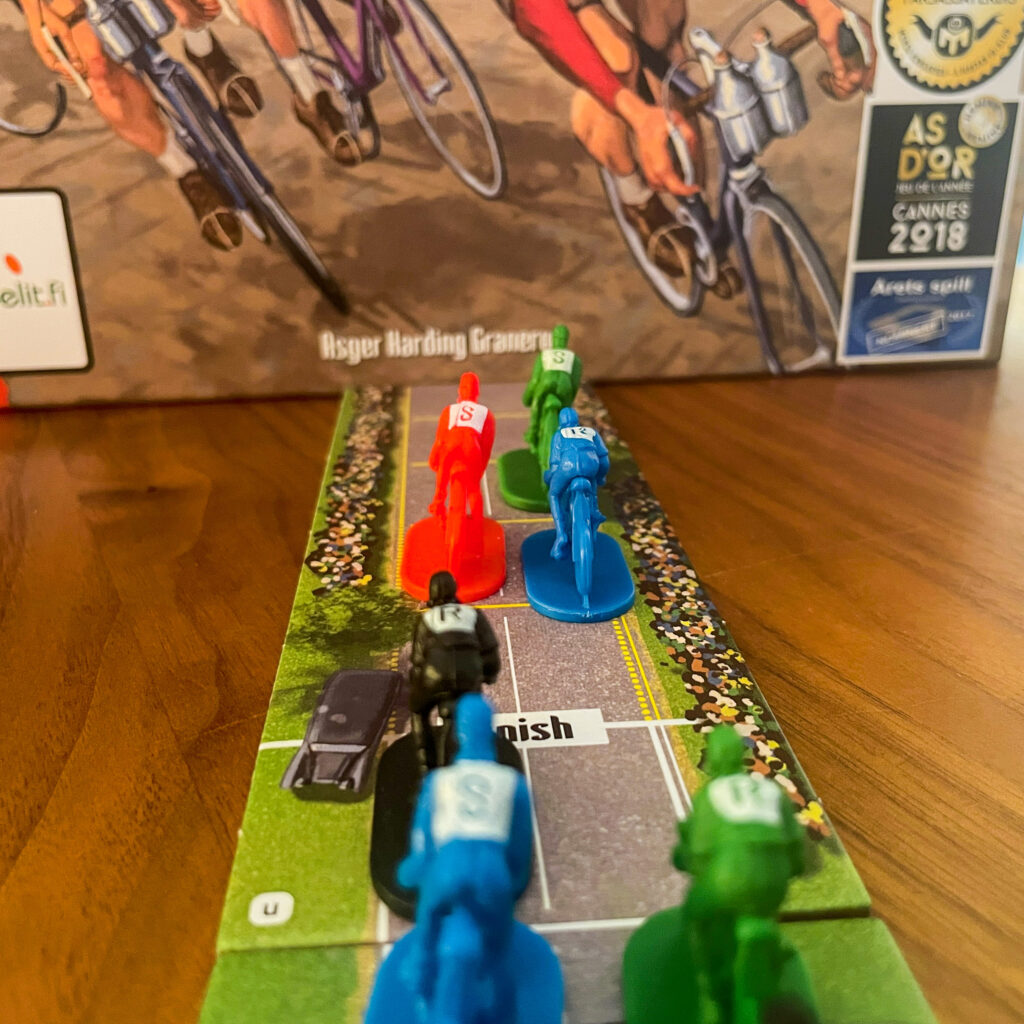
Flamme Rouge is a fast-paced, tactical cycling race game in which each player controls a team of two riders: a Rouleur and a Sprinter. The goal? Be the first to cross the finish line with one of your riders. If multiple riders cross in the same round, the one who made it furthest past the line wins.
You move your riders forward by playing cards, each showing how far that rider can go.
The race plays out over several rounds, each round has three phases:
Energy Phase In the first phase every player draw 4 cards and play 1 card face down, you do this for each rider so you have 1 card for the sprinter and 1 card for the rouleur.
Movement Phase: In this phase all the played cards are revealed and riders move forward according to the number on their card.
End Phase: In the last phase you remove the played cards, check for slipstreaming and exhaustion cards,
Let’s take a closer look at the different phases:
Phase 1 Energy Phase
Each player draws cards and chooses how far each of their riders will move.
Step 1 – Choose a Rider and Draw Cards
Pick either your Sprinter or Rouleur and draw four cards from their energy deck.
Step 2 – Play and Recycle
Choose one of those four cards and place it face down next to the matching rider’s deck. This card will determine their movement this round. The remaining three cards are recycled back into that rider’s deck.
Step 3 – Repeat
Now repeat Steps 1 and 2 for your other rider. Once all players have selected one card for each rider, move on to the next phase.
Phase 2 Movement Phase
Turn all played cards face up. Starting with the rider furthest ahead on the track, each rider moves forward the number of spaces shown on their card.
Phase 3 End Phase
Time to wrap up the round with some clever mechanics.
Step 1 – Remove Played Cards
All cards that were played this round are removed from the game and placed on each rider’s personal discard pile.
Step 2 – Apply Slipstreaming
Starting with the group of riders at the back of the race, check for slipstreaming opportunities.
Slipstreaming applies when there is exactly one empty space between two packs of riders. If so, the rear pack (even if it’s a solo rider) gets to move forward one extra square to close the gap. The two groups then become one pack. You then check again, can this new pack slipstream further? Keep checking and merging until no more slipstreaming is possible
A pack is defined as one or more riders with no empty spaces between them.
Step 3 – Assign Exhaustion Cards
This is where things get tricky. Riders who end the round at the front of a pack (with no one in front of them) receive an exhaustion card. Take one exhaustion card that matches the rider and place it on top of their deck. These cards have low movement values and will slow you down, so you’ll want to manage them carefully. Still, sometimes it’s worth it to take the lead!

Alternative Stages
The track tiles are double-sided, which allow for very varied setups. There are 6 suggested stages you can try, each with their own Stage card. Feel free to also create your own tracks!

Mountains
Mountains can either help or hinder you, depending on how you ride them. There are two types of mountain road segments:
Ascents – marked by red road edges: the uphill climb.
Descents – marked by blue road edges: the downhill ride.
And remember “if you go up, you’ll have to come down”.
The Ascents rules
During the Movement Phase, if a rider starts on, moves onto, or crosses a red Ascent square. Slipstreaming is not allowed on Ascents. Riders neither give nor receive slipstreaming bonuses while on red spaces.
The Descents rule:
If a rider starts their movement on a blue Descent square. Slipstreaming works as usual on Descents and may be applied during the end phase. The movement card played always has a minimum value of 5. If a card with a lower value is played, it is automatically boosted to 5. Higher-value cards work normally and are not limited.

The Game Ends
The player whose rider crosses the finish line first wins the game. If multiple riders cross the finish line in the same round, the winner is the one who has advanced the furthest beyond the finish line.
Conclusion & end score
Difficulty: 1.70/ 5
Re-playability: 8
Our score: 8,5 out of 10 dice
We’re big fans of this fantastic game! Flamme Rouge fully immerses you in the world of cycling, and once you’re in, you can’t help but get competitive with the other players. One of the great things is that you can build your own race tracks or use the suggested stage layouts provided in the box.
Flamme Rouge had been on my wishlist for a while, but I wasn’t sure if it would be a hit at home, after all, I’m the only real cycling enthusiast in the family. But luckily, everyone ended up loving it too! What makes it so interesting is that you can’t just keep playing high-value cards. Doing so will clog your deck and eventually exhaust your riders. Sometimes you’ll need to hang back, take the lead, or stay nestled in the peloton and timing is everything.
The base stage is perfect for learning the game, but it quickly leaves you wanting more. Adding mountains introduces a new layer of strategy on Ascents, high-value cards are capped, while Descents let you speed up even when playing low-value cards. You can recreate real-life cycling routes (perfect for die-hard fans), or build your own, as long as everything connects correctly. And if you’re looking for even more variety, there are tons of fun custom tracks online and several official expansions too (more on those coming soon!).
Even though Flamme Rouge has been around for a while, it doesn’t feel dated at all. The rules are short, crystal clear, and easy to teach. The game is often compared to HEAT, which makes sense because they share the same designers. But make no mistake, the two games play very differently. They absolutely deserve their own place in your collection. HEAT is slightly more complex while Flamme Rouge is perfect to play with my 9-year-old son, HEAT required more explanation, and we’ve shelved it for now until he’s a bit older.
Thanks to Lautapelit for this review copy and the opportunity to write about this game.