Summary
👥 A game for 2 to 5 players
⏳ Playing time is around 100 minutes
🏢 Publisher is Devir Games

Introduction
The void is silent. Not because it is empty, but because it has witnessed civilizations rise, wage war, and vanish without leaving so much as a whisper behind.
Ancient star systems drift through the darkness, their secrets buried beneath forgotten ruins, while colossal trade fleets carve luminous paths across an endless sea of black. Somewhere beyond the edge of the known galaxy, power waits to be claimed, not by the strongest, but by those bold enough to seize it.
This is the universe of Transgalactica.
Here, exploration is only the beginning. Every new sector hides opportunity, every technological breakthrough shifts the balance of power, and every decision sends ripples across a living galaxy where influence is earned rather than given. Empires are not built through luck, but through vision, calculated ambition, and the willingness to push ever deeper into the unknown.
But in the cold darkness between the stars, ambition alone is never enough. The question is whether Transgalactica truly reaches those distant horizons or disappears into the void that has consumed so many before it.

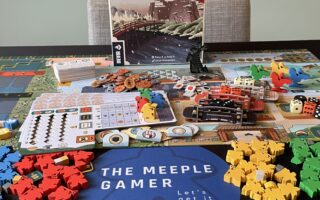
Let’s get it on the table
The central game board (Operations Panel) is placed in the middle of the table and serves as the heart of the game.
Depending on the player count, the appropriate Galaxy Map is added before the different markets and tracks are prepared.
The Basic and Advanced Bonus tiles are shuffled separately and distributed across their designated spaces on the Technology, Military, Production, Politics and Round tracks, ensuring that every game begins with a unique combination of rewards.
Next, the galaxy itself takes shape. The various planet tiles are shuffled and placed onto the Galaxy Map, with the starting Action Planets occupying the central locations while the remaining planets fill the surrounding sectors. Bonus tiles are placed on the Action Planets, pirate tokens are randomly assigned to all eligible worlds, and the Mining tiles are prepared, with one being dealt to each player and another placed on the Mining action space.
The different card decks are then prepared individually. The three Technology decks are shuffled separately, after which three cards from each level are revealed on the Technology Track. The two Mission decks are also shuffled independently, with three missions from each deck displayed on the Politics Track while the remaining decks are placed beside the board. Finally, each of the four Galactic Decree decks is shuffled, and one card from each deck is revealed in its corresponding slot on the Operations Panel. Once the resource supply, credits, pirate tokens, and remaining components have been placed within easy reach of all players, the galaxy is fully prepared for exploration.
Resource supplies are organized within easy reach of every player, while the different markets and display areas are filled with their starting cards and tiles according to the setup instructions.
Once the galaxy itself has been prepared, each player builds their own command area.
A player board is placed in front of each participant, together with the matching fleet of ships, influence markers, cubes, and other faction-specific components. Starting resources are collected, the initial technologies and markers are placed on their designated spaces, and the starting cards are drawn.
Finally, the first player is determined, the remaining tokens are placed within reach, and the game is ready to begin.
Although there are quite a few individual steps involved, the setup follows a logical sequence that quickly becomes familiar after the first play. Thanks to the clear organization of the components and the well-structured player boards, preparing the galaxy becomes increasingly efficient, allowing players to focus on what truly matters: exploring the unknown and building the most influential civilization among the stars.

Once the galaxy has been prepared and every player has established their headquarters, Transgalactica unfolds over a series of rounds in which players continuously expand their influence across multiple interconnected systems.
Rather than following a traditional worker placement or action selection format, the game revolves around carefully managing your fleet, developing new technologies, completing missions, and exploiting opportunities on an ever-changing galactic map. Every decision influences several aspects of your civilization simultaneously, making long-term planning just as important as reacting to the current state of the game.
During a player’s turn, a ship is deployed to one of the available action spaces on the Operations Panel. Each action not only grants its immediate benefit but also allows the corresponding track to advance. This is one of Transgalactica’s defining mechanics, as progress on these tracks unlocks increasingly valuable rewards and permanent improvements throughout the game.
Choosing an action is therefore rarely about its direct effect alone; it is equally about determining which aspect of your civilization deserves further investment.
The Exploration track encourages players to venture deeper into the galaxy by discovering new planets and expanding their presence beyond the central sectors. Newly explored worlds often provide valuable bonuses, additional opportunities, or strategic positions that can be exploited later in the game. Since the galaxy gradually opens as players advance, controlling key locations becomes increasingly important.
The Technology track focuses on scientific advancement. By researching new technologies, players acquire powerful cards that introduce permanent abilities, efficiency improvements, or new strategic possibilities. Early technologies provide a solid foundation, while higher-level research unlocks increasingly sophisticated combinations that can significantly alter the direction of an empire. Developing technology also creates powerful engine-building opportunities, allowing future actions to become progressively stronger.
Military development represents another important pillar of the game. Advancing along this track strengthens your fleet and improves your ability to deal with pirates that occupy several planets throughout the galaxy. Defeating these threats not only secures safer trade routes and access to valuable locations, but also rewards players with victory points and additional bonuses. Investing in military strength is therefore both a defensive necessity and an attractive scoring opportunity.
Economic growth is represented through the Production track. Increasing production generates a more efficient flow of resources and credits, allowing players to execute increasingly ambitious plans without constantly struggling for income. Since nearly every advanced action requires careful resource management, maintaining a healthy economy often determines whether an empire continues to grow or gradually falls behind.

Political influence forms the final major development path. Through the Politics track, players complete missions, gain influence within the Galactic Senate, and manipulate the various Galactic Decrees that shape the course of the game. Missions reward players for achieving specific objectives, while the decrees introduce changing priorities that encourage different strategic approaches from one game to the next. Investing in politics often provides substantial endgame rewards for players capable of fulfilling these long-term objectives.
While each development track offers its own rewards, Transgalactica constantly encourages players to combine them. Technological breakthroughs improve exploration, economic development fuels military expansion, and political influence often complements every other aspect of an empire. Focusing exclusively on a single strategy is rarely sufficient, as the game continuously rewards players who recognize opportunities across multiple systems and adapt to the evolving state of the galaxy.
The game progresses until the final round is triggered according to the endgame conditions. Once every player has completed an equal number of turns, the final scoring begins. Players add together the victory points accumulated during the game with points awarded for completed missions, fulfilled Galactic Decrees, explored planets, technological achievements, military accomplishments, political influence, remaining resources, and various card effects earned throughout the session.
Because scoring is distributed across so many interconnected systems, the winner is seldom obvious before the final tally. It is not uncommon for carefully planned endgame bonuses to dramatically reshape the standings, rewarding players who successfully balanced short-term efficiency with long-term strategic planning throughout their journey across the galaxy.

Final Conclusion & rating
Weight: 3.70/ 5
Replayability: 7
Our rating: 7 out of 10 dices
Transgalactica is an ambitious Eurogame that successfully blends exploration, engine building, resource management, and multiple progression systems into a rewarding strategic experience.
Every action feels meaningful, as advancing along one track often creates opportunities on another, encouraging players to think several turns ahead while constantly adapting to the changing state of the galaxy. The interconnected mechanics are undoubtedly the game’s greatest strength and provide plenty of replayability, especially as different technologies, missions, and Galactic Decrees ensure that no two sessions unfold in exactly the same way.
Visually, the game is equally impressive. The artwork perfectly captures the vastness of space, the production quality is solid, and once the board is fully set up, Transgalactica becomes a real eye-catcher on the table. We were particularly pleased to use the Folded Space insert during setup, as it significantly reduced the preparation time and kept the many components well organized. Considering the amount of material included in the box, it genuinely enhances the overall experience.
Unfortunately, the production is not without its flaws. One of the more disappointing decisions is the inclusion of stickers that can be applied to several components to improve their functionality during play. These really should not have been necessary in the first place, as directly printed components would have offered a far more premium solution. Even more frustrating is the fact that some of these stickers, particularly those applied to the Outposts, do not always stay firmly attached. For a game of this quality and price point, this feels like an unnecessary compromise that could have been avoided.
Another weak point is undoubtedly the rulebook. While the underlying mechanisms are elegant once understood, learning the game can be more difficult than it should be. Several rules lack clarity, forcing players to search for answers online or interpret situations themselves. This has been a recurring criticism within the board gaming community, and after playing the game ourselves, it is difficult to disagree. A clearer structure, better examples, and more precise explanations would have made the first few plays considerably smoother.
With two players, Transgalactica already offers an enjoyable and highly strategic experience, providing meaningful decisions from start to finish. However, the game truly comes alive with a larger player count, where increased competition for planets, technologies, and objectives creates a more dynamic and interactive experience. The galaxy simply feels more alive when multiple civilizations compete for the same opportunities.
Perhaps the greatest compliment and at the same time the biggest criticism, is that Transgalactica leaves the impression that it could have been even better. Knowing that it was designed by Daniele Tascini inevitably raises expectations, and while the foundations are undeniably excellent, the final product feels as though it was released just a little too early. With a more polished rulebook, a few production improvements, and some additional refinement, this could easily have been one of the standout Eurogames in its genre.
As it stands, Transgalactica remains a very good game that rewards strategic planning and repeated plays. It is beautiful to look at, satisfying to explore, and packed with meaningful decisions. Yet, despite all its strengths, it falls just short of becoming the masterpiece many players had hoped for.
Rather than reaching the stars without compromise, it settles comfortably among the better modern Eurogames, a journey well worth taking, even if it never quite achieves escape velocity.
🙏 Thanks to Devir Games for providing this review copy and the opportunity to write about it.