Summary
👥 A game for 2 – 5 players
⏳ Play time is 45 – 90 minutes
🏢 Publisher is Skellig Games

Introduction
New York, 1931.
The city never truly sleeps—it merely changes hands. Behind the glow of neon signs and the roar of passing automobiles, another world comes alive. A world where loyalty is bought, promises are temporary, and every street corner belongs to someone willing to spill blood to keep it. The era of Prohibition has transformed whiskey into gold, and the men who control its flow have become kings without crowns.
The war has gone on for years. Bullets have settled disputes that words never could, and entire neighborhoods have become battlegrounds in an endless struggle for power. But even the most ruthless crime families understand that chaos is bad for business. A fragile agreement is forged. New York will be divided, territory by territory, district by district. Yet everyone around the table knows one thing: peace is nothing more than another weapon waiting to be used.
In Five Families, you step into the polished shoes of a Mafia boss determined to outsmart, outmaneuver, and outlast every rival. Every mobster you send onto the streets is an investment, every district another source of income, and every decision a gamble between expanding too quickly or striking at precisely the right moment. Alliances don’t exist, only opportunities. Trust has no place here, because today’s business partner may become tomorrow’s target.
Power isn’t earned with honor. It is built through intimidation, calculated ambition, and offers that no one dares refuse. The city is waiting for its next kingpin. The only question is how much of New York will bear your family’s name when the smoke finally clears.

Let’s get in on the table
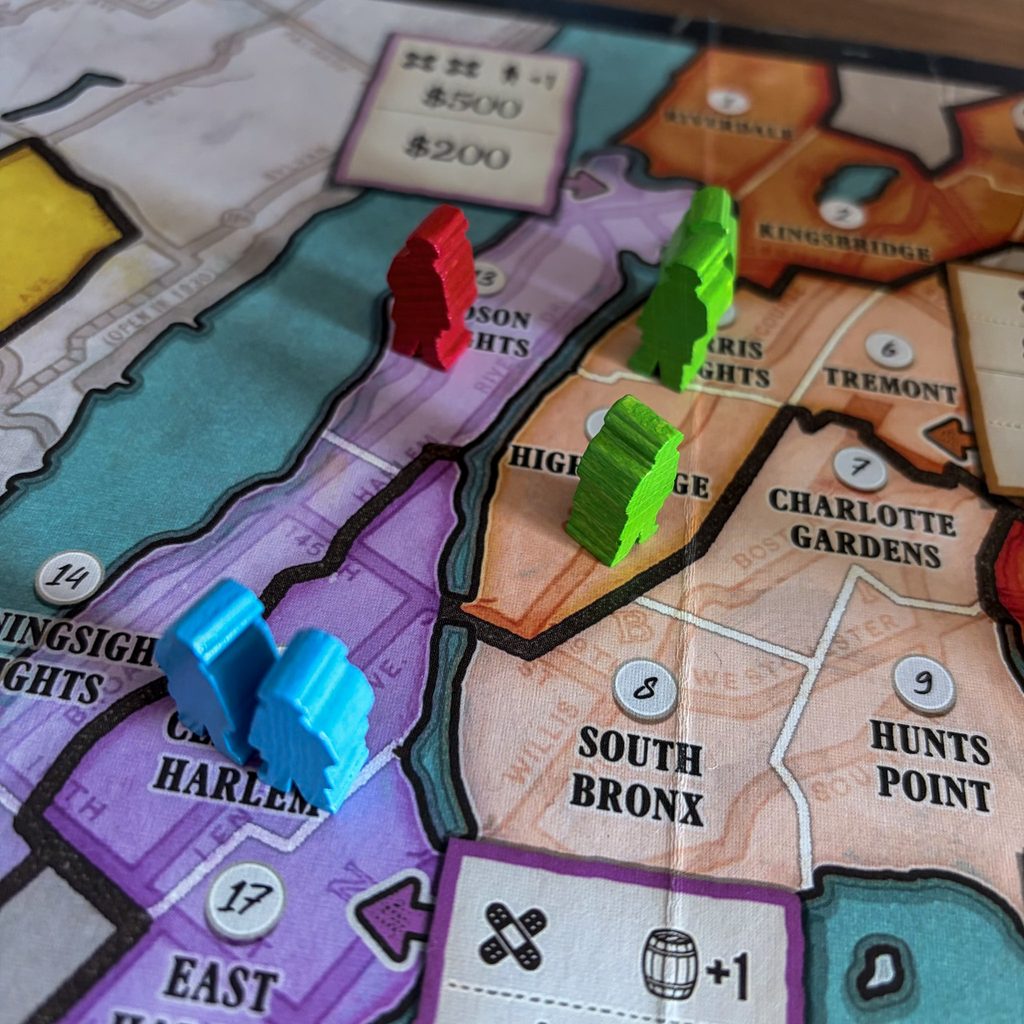
Setting up Five Families is a straightforward process that immediately establishes the struggle for control of New York City. The game board is placed in the center of the table, after which the district cards are sorted according to the number of players. Any cards not required for the chosen player count are removed from the game. In games with fewer than five players, the remaining Mafia families still participate indirectly. Their district cards are shuffled into separate stacks, and mobsters belonging to these non-player families are placed on the corresponding districts of the board, ensuring that every one of the Five Families is represented from the very start of the game.
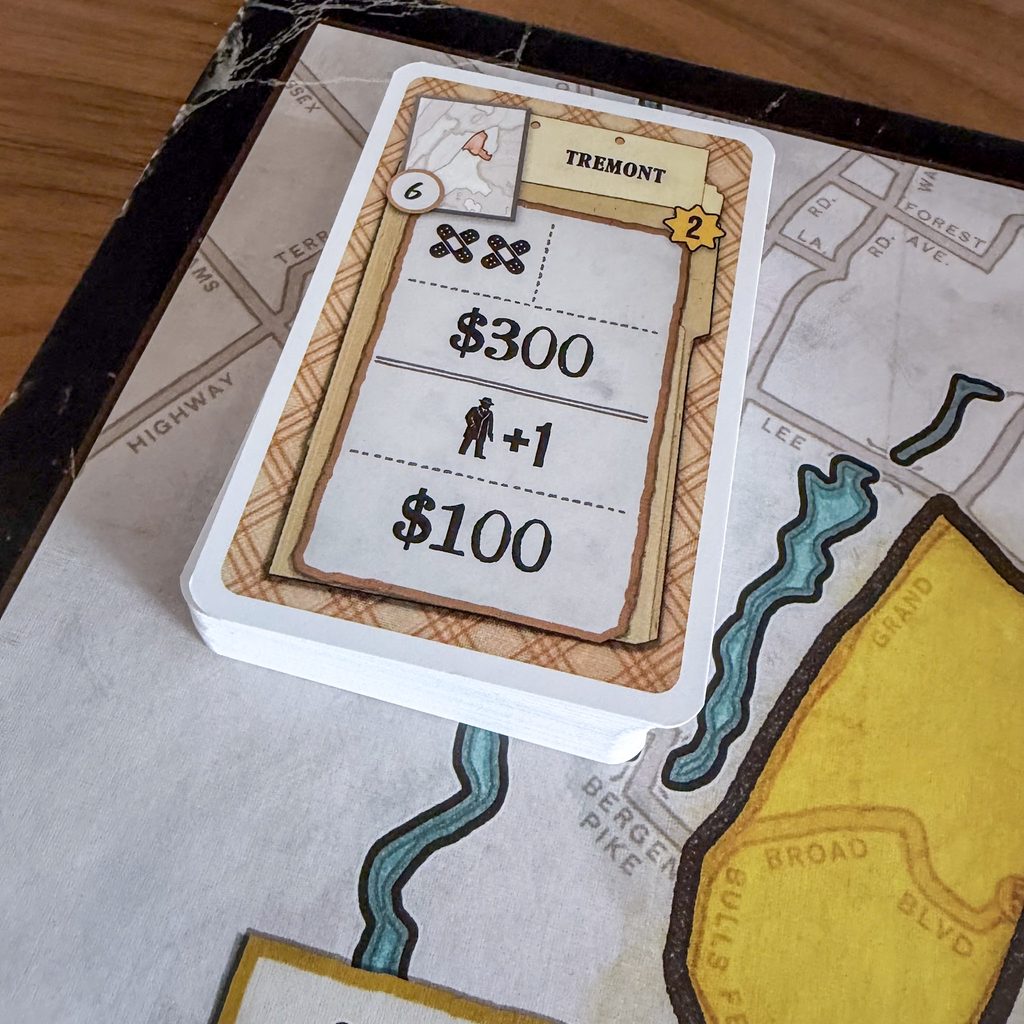
Once the board has been prepared, the Market is created by shuffling the remaining district cards and revealing a number of cards equal to six plus the number of players. These face-up cards form the available districts that players can claim throughout the game, while the remaining cards are placed face down as the draw pile beside the board.
Each player then chooses a Mafia family and receives all components in the matching colour, including their mobsters, six cars used to mark controlled areas, and a single barrel token. Depending on the player’s position in the turn order, everyone receives a different amount of starting money and a specific number of mobsters, creating a small balancing effect that compensates later players with slightly larger starting resources. The mobsters are divided into an active supply, which represents the gangsters currently available for use, and a passive supply, from which additional mobsters can be recruited during the game. Keeping these two supplies separate is essential, as only mobsters in the active supply can be deployed to claim territory.
Before the first round begins, each player also claims an opening district. Starting with the last player in turn order and proceeding counterclockwise to the starting player, everyone selects a district card from the Market and places it into their personal claim area. The required number of mobsters is immediately assigned to that district, based on its resistance value, marking the family’s first attempt to expand its influence across the city.
With the streets populated, the Market prepared, and every family already competing for its first piece of territory, New York is ready for the inevitable power struggle. The setup is both thematic and functional, placing every player directly into the escalating battle for dominance before the first turn has even begun.
Let’s play
Once the city has been divided and every family has established its first foothold, the battle for New York truly begins. Five Families is played over a series of turns, with each player acting in clockwise order. Every turn consists of three consecutive phases: taking control of previously claimed districts, performing a single claim action, and finally collecting income from all districts already under your control. Although the structure is remarkably simple, the decisions within each phase create a surprisingly tense struggle for territory, resources, and long-term influence.
The first phase is all about turning ambition into ownership. Any district resting in your personal Claim Space can now be brought under your permanent control, provided you are willing and able to pay the required cost. Every mobster assigned to a claimed district costs money before that district officially becomes yours, making financial management just as important as territorial expansion. Once the cost has been paid, any injuries caused by the district’s resistance are resolved by moving the required number of mobsters back to your passive supply. The remaining gangsters are transferred from the district card onto the matching district on the game board, physically marking your family’s presence on the streets of New York. The district card itself is moved into your Control Space, where it can no longer be stolen by your rivals and will begin generating income at the end of every one of your turns.
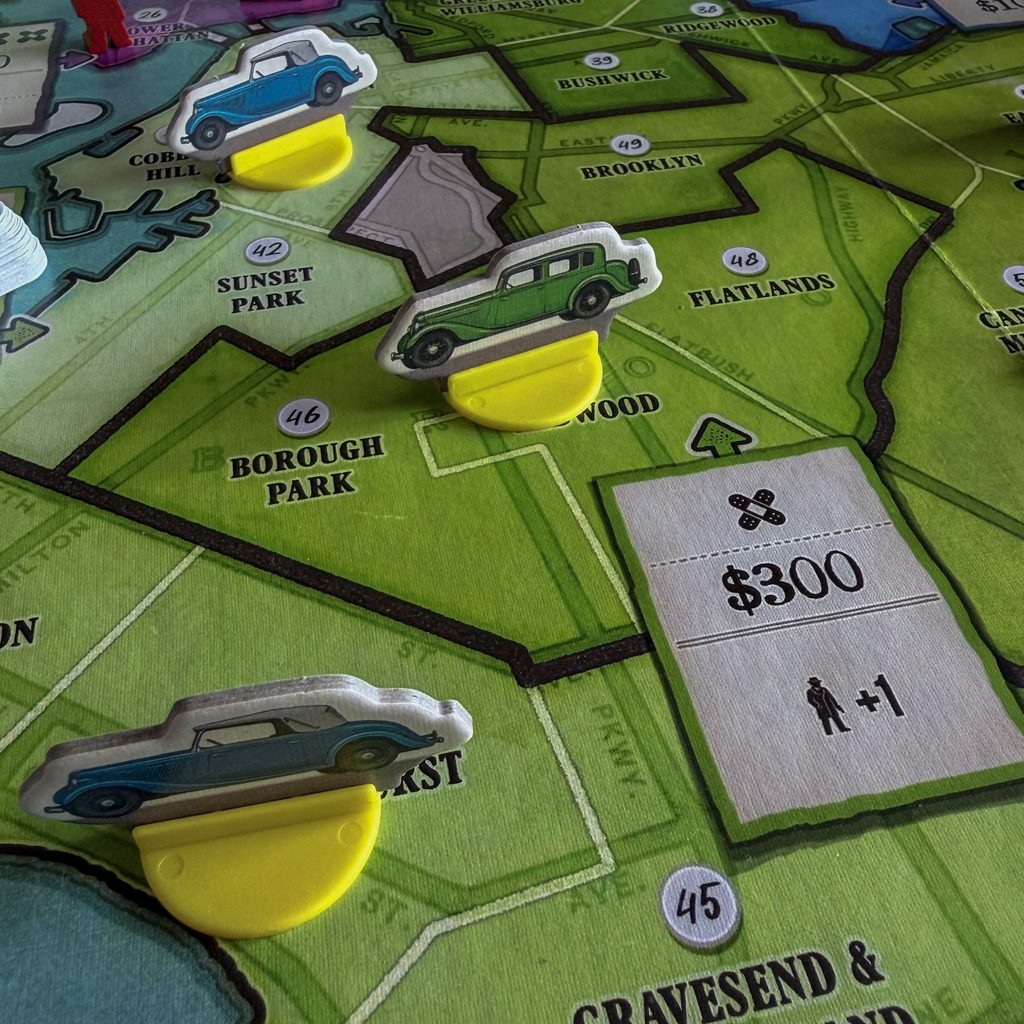
Whenever the third district belonging to the same neighbourhood is brought under control by any player, an Area Scoring immediately takes place. Control of an area is not determined by the number of districts owned, but primarily by the total number of mobsters occupying those three districts. Only when players are tied does the number of controlled districts become relevant, followed by turn order if another tie remains. The winning family places one of its cars on the corresponding area of the board, permanently claiming that neighbourhood and securing valuable victory points for the end of the game. Afterwards, every mobster involved in that area returns to its owner’s passive supply, meaning that maintaining influence requires careful timing rather than simply flooding the board with figures.

The second phase forms the heart of every turn. Here, players choose one of four possible actions, each serving a different strategic purpose. The most common action is claiming a district directly from the Market. A district card is selected, placed into your Claim Space, and immediately occupied with at least the minimum number of mobsters required by its resistance value. Stronger districts require larger crews to intimidate the local opposition, although committing additional mobsters often provides better protection against rival families looking to seize the opportunity for themselves.
Instead of expanding into untouched territory, players may decide to take over a district that has already been claimed by another family but has not yet been secured. To accomplish this, a larger group of mobsters must be committed than currently occupies the card. The opposing mobsters retreat safely to their owner’s active supply, while the displaced family receives two barrels as compensation for losing the district. This constant threat of having valuable claims stolen creates much of the game’s interaction, forcing players to carefully judge whether to secure districts quickly or continue expanding elsewhere.
Players may also reinforce one of their own claimed districts by adding additional mobsters. While this may seem like a defensive action, it also serves several offensive purposes. A stronger presence makes the district far more difficult to steal, increases your chances of winning future area majorities, and can even trigger a direct takeover. Whenever a district contains at least five more mobsters than its resistance value, control is immediately established without waiting for a future turn, provided the required payment can still be made. This creates exciting tactical moments where a carefully prepared district can suddenly become a permanent asset before opponents have the chance to interfere.
If none of the available options seem attractive, players may instead pass. Passing grants additional money together with two mobsters transferred from the passive supply into the active supply, ensuring that players who temporarily fall behind still have an opportunity to rebuild their criminal empire instead of becoming completely stalled.

Throughout the game, barrels of illegal alcohol function as valuable wild cards. They can be exchanged for additional cash whenever money becomes scarce, converted into extra mobsters by recruiting from the passive supply, or spent to perform an additional Claim action during the same turn. Since multiple barrels may be used together, they provide enormous flexibility and often enable explosive turns in which several districts are claimed or reinforced in rapid succession.
The final phase of every turn is dedicated to income. Every district resting safely within your Control Space generates the resources shown on its card, rewarding money, additional mobsters, barrels, or a combination of all three. This steady income forms the economic engine of your family, allowing increasingly ambitious expansion as the game progresses. Districts that remain in your Claim Space, however, generate nothing until they have officially been brought under control, making the timing of your investments an important strategic consideration.
As the Market gradually empties and fewer districts remain available, competition becomes increasingly fierce. Every newly controlled neighbourhood has the potential to trigger another Area Scoring, while players constantly weigh immediate expansion against protecting the territory they have already invested in. Since money, mobsters, and barrels are all interconnected, every decision influences the options available during future turns.
The game concludes the moment every district in New York has been brought under permanent control and the final Area Scoring has been resolved. During the final tally, players add together all Influence Points shown on the district cards in their Control Space. Each neighbourhood marked with one of their cars awards an additional five victory points, making area control just as important as simply collecting valuable districts. Money, unused mobsters, and remaining resources have no value once the game ends, rewarding players who invested everything into expanding their family’s influence. The Mafia family with the highest total of Influence Points is declared the undisputed ruler of New York’s criminal underworld.

Conclusion & end score
Difficulty: 2.25/ 5
Re-playability: 7
Our score: 7 out of 10 dice
Five Families is one of those games that immediately grabs your attention with its theme but manages to keep you engaged because of its surprisingly elegant gameplay. Beneath its Mafia setting lies a streamlined area control game that combines tactical decisions, resource management, and player interaction into a remarkably accessible package. The rules are easy to learn, turns move quickly, and every decision carries weight as players constantly balance expansion, income, and the risk of leaving valuable districts vulnerable to rival families.
One of the game’s greatest strengths is its level of interaction. Unlike many modern Eurogames that focus primarily on optimizing your own engine, Five Families encourages direct confrontation without ever becoming overly punishing. The ability to steal claimed districts, reinforce your own territories, and strategically compete for area majorities creates a constant sense of tension. Every claimed district can become the target of another family, forcing players to anticipate each other’s intentions rather than simply executing their own plans in isolation.
The area scoring mechanism is another highlight. Rather than rewarding players solely for controlling the most districts, the game cleverly emphasizes timing and mobster placement. Choosing when to invest heavily in a neighbourhood, when to conserve resources, and when to trigger an area scoring creates meaningful dilemmas throughout the game. Combined with the versatile barrel system, which provides additional flexibility at critical moments, the gameplay remains engaging from the opening turns until the final district is secured.
The production quality is equally impressive. The artwork successfully captures the atmosphere of Prohibition-era New York without becoming overly dark or exaggerated, while the components are functional and easy to distinguish during play. The board remains readable despite the growing number of mobsters, making it easy to assess the constantly shifting balance of power across the city. The thematic integration deserves particular praise, as nearly every mechanism feels connected to the struggle between rival Mafia families.
If there is one criticism echoed by many players, it is that luck can occasionally influence which district cards appear in the Market and when certain neighbourhoods become available for completion. While experienced players can usually adapt to these changing circumstances, the timing of key cards can sometimes benefit one family more than another. Fortunately, the game’s tactical flexibility generally allows players to pursue alternative opportunities rather than feeling locked into a single strategy.
Perhaps the greatest compliment that can be given to Five Families is how much strategic depth it delivers with relatively straightforward rules. Friedemann Friese has created a game that is approachable enough for experienced families and casual gamers, yet offers sufficient tactical depth to satisfy seasoned strategy enthusiasts. The elegant balance between accessibility and meaningful decision-making makes it a title that is easy to teach but rewarding to master.
Ultimately, Five Families is not a sprawling epic filled with countless mechanisms or overwhelming complexity. Instead, it focuses on doing a handful of things exceptionally well. Fast-paced turns, constant player interaction, meaningful tactical choices, and a wonderfully integrated Mafia theme combine into an experience that remains entertaining from beginning to end. It may not redefine the area control genre, but it delivers exactly what it promises: an engaging battle for New York’s underworld that leaves players eager to sit down for another round and prove that their family deserves to rule the city.
We want to thank for this review copy and the opportunity to write about this game.
Thanks to Skellig Games for this review copy and the opportunity to write about this game.