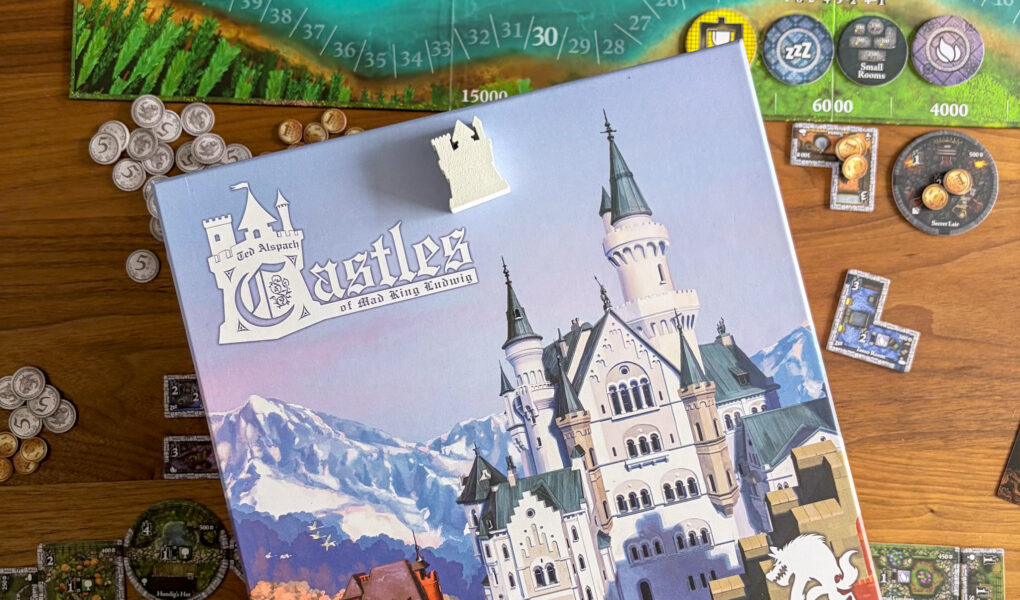

Summary
👥 A game for 1 to 4 players
⏳ Playing time is ~90 minutes
🏢 Publisher is Bezier Games

Introduction
Thunder echoes across the Bavarian mountains. A royal decree shatters the silence. The eccentric King Ludwig II demands the most magnificent castle ever conceived not built by architects, but by visionaries willing to embrace brilliance, ambition, and just a touch of insanity. Every corridor leads to opportunity. Every room tells a story. Every decision could turn your dream palace into a legendary masterpiece… or an expensive labyrinth.

Setting up the game
Place the main game board in the center of the table and sort all room tiles by their size into separate face-down stacks. Shuffle each stack individually and reveal the required number of rooms of each size to create the current market.
Shuffle the Bonus Cards and reveal the appropriate number based on the player count.
Shuffle the Favor Tiles and place them within easy reach of all players.
Each player receives a Foyer tile, which serves as the starting room of their castle, along with a player board, a scoring marker, and the starting amount of money determined by the number of players. Every player also receives a secret Bonus Card that will provide additional end-game scoring opportunities.
Determine the first Master Builder, who receives the Master Builder marker. This player is responsible for setting the prices of the available rooms during the first round.
Place the remaining money, Corridor tiles, and other game components nearby to form the general supply. Once the room market has been filled, the Bonus Cards have been dealt, and every player has placed their Foyer in front of them, the game is ready to begin.

Let’s get it on the table
At the beginning of every round, the current Master Builder fills the room market with new room tiles from the appropriate stacks.
Their first responsibility is to assign a price to every available room. The prices may range from inexpensive bargains to costly luxury rooms, and this decision is one of the most strategic parts of the game. Pricing rooms too low allows opponents to buy valuable rooms cheaply, while setting prices too high may prevent anyone from purchasing them. The Master Builder earns all extra income from rooms sold above their printed value, making clever pricing essential.
Starting with the player to the left of the Master Builder and continuing clockwise, each player purchases one room from the market by paying its listed price. The purchased room must immediately be connected to an existing doorway in their castle. Every doorway must connect to another doorway, while walls cannot overlap or leave gaps between connected rooms. As the castle expands, players gradually create a unique layout consisting of bedrooms, utility rooms, outdoor spaces, hallways, and luxurious chambers.
Every room tile contains several pieces of information. The room’s name appears at the top, while its purchase value is shown in the upper corner. This value also determines how much profit the Master Builder receives if the room is sold above its base price. Many rooms display one or more icons representing room types, such as sleeping rooms, activity rooms, utility rooms, food rooms, or outdoor areas.
These room types become increasingly important because many rooms award points based on adjacent room types or the total number of specific rooms in your castle. Most rooms also contain a special ability or scoring condition printed directly on the tile. Some effects trigger immediately when the room is placed, others activate whenever another room is added later, and some only score during the final evaluation.
After purchasing a room, players immediately resolve any “When Completed” ability if all of the room’s doorways have been connected. Many rooms reward players with additional money, bonus points, Favor Tiles, or allow them to manipulate their castle in unique ways. Rooms that are not yet fully surrounded remain incomplete until every doorway has been connected. Completing rooms efficiently becomes an important long-term strategy because many of the strongest rewards only become available once a room is fully enclosed.

Corridors play a special role throughout the game. They may be purchased like normal rooms and are often used to reach difficult spaces within the castle or create additional expansion opportunities. Because they are inexpensive and flexible, corridors help players complete rooms or prepare for larger combinations later in the game.
Scoring occurs continuously throughout the game as many rooms immediately award Victory Points when placed or completed. Certain rooms score based on adjacency, rewarding players for placing bedrooms next to utility rooms, food rooms beside dining halls, or activity rooms near entertainment areas. Other rooms award points according to the total number of specific room types already built. Because every room has unique scoring conditions, careful planning is far more rewarding than simply constructing the largest castle.
At the end of the game, players perform final scoring. Secret Bonus Cards award additional Victory Points for meeting their individual objectives, such as building large numbers of certain room types, completing many rooms, or creating specific castle layouts. Several rooms and King’s Favor Tiles also contain end-game scoring effects that are resolved only after the final room has been placed. Any remaining bonuses are calculated, and the player with the highest total Victory Point score is declared the winner.

Final Conclusion & rating
Weight: 2.65/ 5
Replayability: 9
Our rating: 8 out of 10 dices
Castles of Mad King Ludwig has earned its reputation as one of the finest tile-laying strategy games, and it’s easy to understand why. The continue changing room market, the clever Master Builder mechanic, and the satisfying process of designing your own castle create an experience that feels fresh every single game. While the rules can seem a little overwhelming during the first play, the gameplay quickly becomes intuitive, rewarding careful planning without ever feeling overly complex.
For us, this is exactly the kind of game that finds its way to the table time and time again. It has enough strategic depth to satisfy experienced players, yet it remains accessible enough to simply pull off the shelf for an enjoyable evening.
One feature we particularly appreciate is the excellent insert included in the box. The game is already quick to set up, but the well-designed organizer makes preparation and cleanup even faster, allowing you to spend more time building castles and less time sorting components.
Perhaps the greatest compliment we can give Castles of Mad King Ludwig is that finishing a game rarely feels like enough. As soon as the final scores are counted, you’re already thinking about different room combinations, better pricing strategies, and how your next castle might turn out. It’s one of those rare games that leaves you wanting “just one more game.” Whether you’re a fan of tile-laying games, economic strategy, or simply enjoy creating something uniquely your own, Castles of Mad King Ludwig is an easy recommendation. It is clever, interactive, endlessly replayable, and remains one of the most charming castle-building games ever published.
🙏 Thanks to Bezier Games for providing this review copy and the opportunity to write about it.