Summary
👥 A game for 2 to 4 players
⏳ Playing time is 75 – 90 minutes
🏢 Publisher is Arcane Wonders

Introduction
The dawn of the American automobile industry was not a gentle ride, it was a brutal race of innovation, ambition, and mechanical supremacy. Factories roared to life, engineers chased impossible breakthroughs, and daring entrepreneurs fought to turn revolutionary ideas into roaring machines.
In Kraftwagen: Age of Engineering, you step directly into this golden age of automotive pioneers, where every decision can propel your company to legendary status or leave it choking on the dust of your rivals.
Design cutting-edge engines, develop ever more desirable car bodies, dominate the emerging marketplace, and prove your engineering excellence on the Grand Prix circuit.
Success demands more than building great cars; it requires mastering production, reading consumer demand, attracting investors, and staying one step ahead in a fiercely competitive industry.
Every turn feels like a battle between the drawing board, the factory floor, and the racetrack.
Start your engines. The race for industrial greatness begins now.

Setting up the game
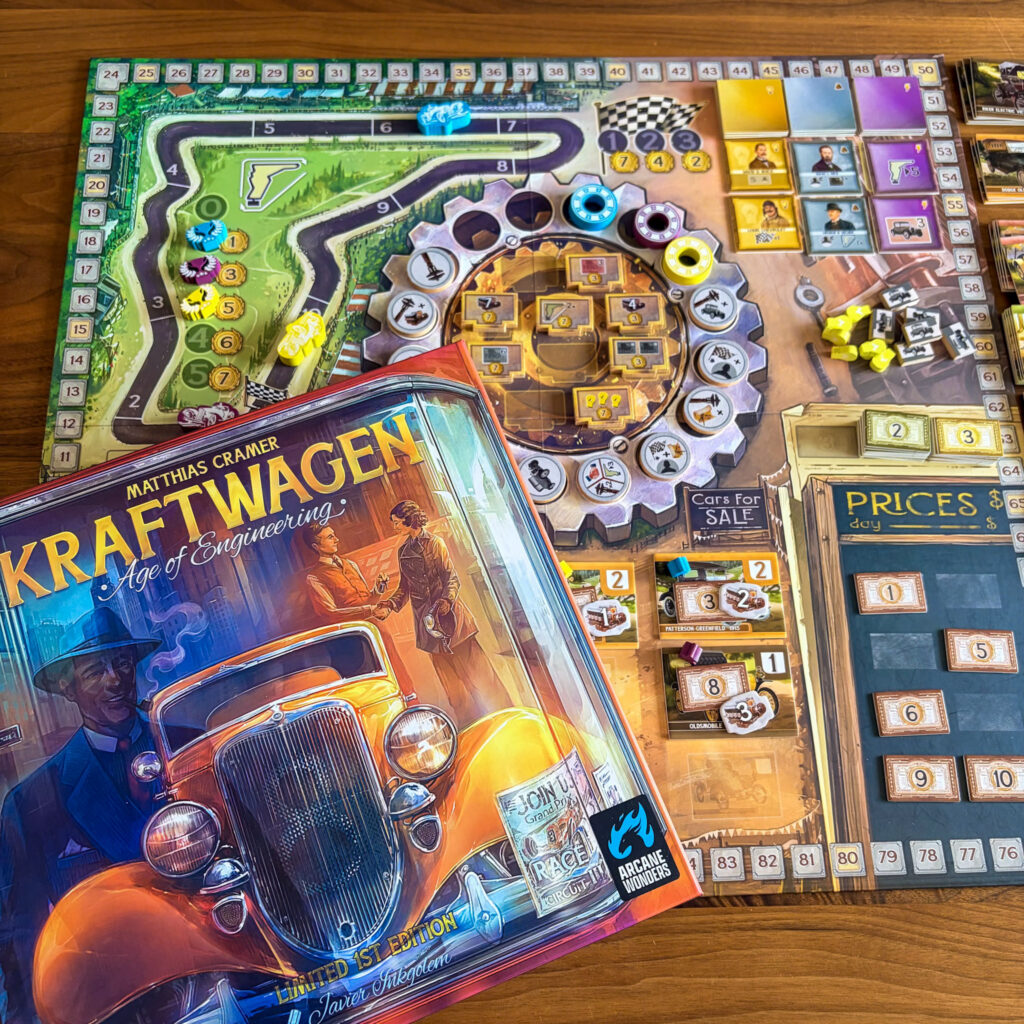
Before the competition for automotive supremacy can begin, the game board is placed in the center of the table and prepared with all of its key elements.
The action tiles are first separated according to the number of actions they provide, shuffled, and then arranged on the large Action Gear to form the Action Chain that will drive player turns throughout the game.
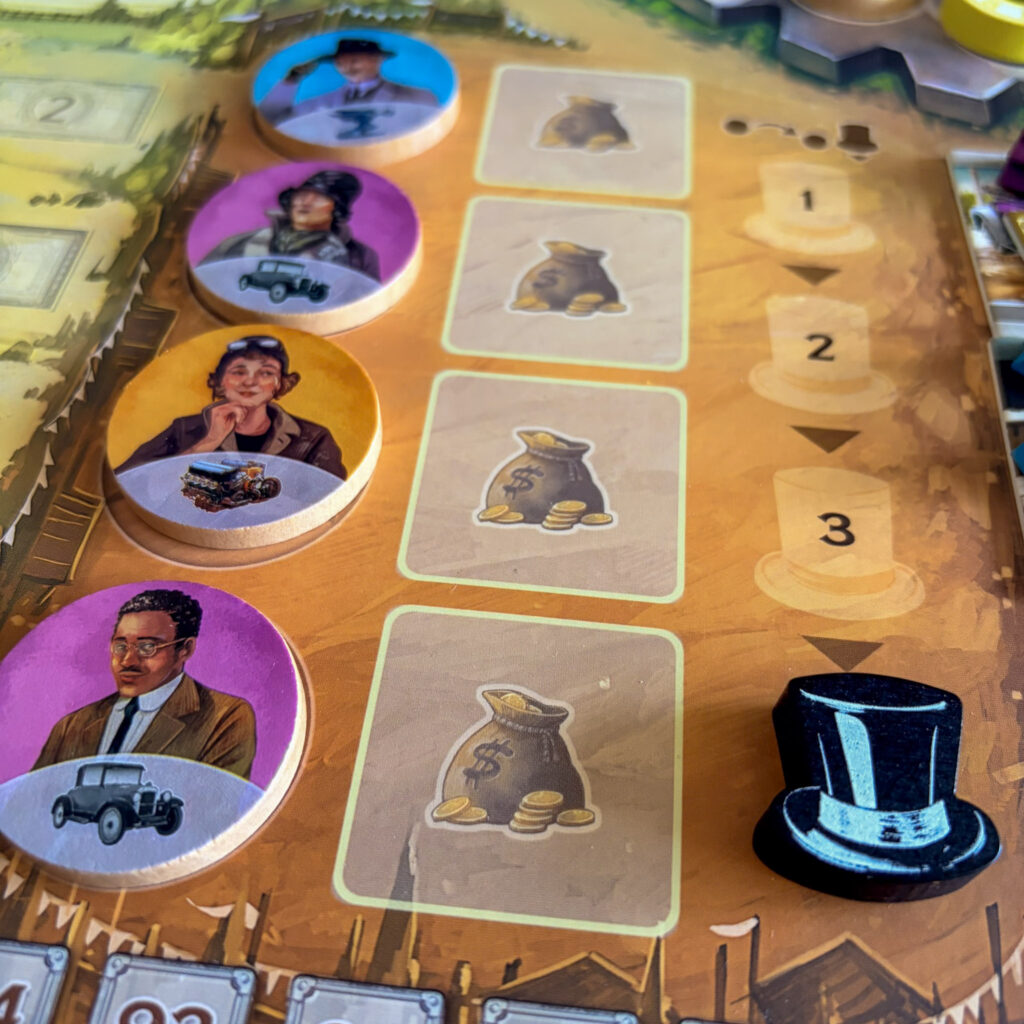
Recruitment tiles are randomized and placed face down in their respective Engineer, Investor, and Instant Benefit spaces, while the Buyer tiles are positioned on the Available Buyers track according to their preference categories.
The Market Marker is placed at the start of the Market Track, the Achievement tiles are positioned on the designated spaces around the Action Gear, and all shared components such as Car Bodies, Engines, Engineering Markers, Price Markers, Engineer Tokens, Production Tokens, and workers are sorted into a common supply within easy reach of all players.
Each player then takes a Company Board and chooses a company colour. They receive four workers and their two Development Gear markers, placing one marker on the first space of the Engine Development Track and the other on the first space of the Car Body Development Track.
The four workers are placed in the Company Canteen, ready to be employed in production, sales, or racing activities.
The player’s Reputation Marker is placed on space zero of the Reputation Track, while their Racing Car starts in the pit lane on the Racing Circuit and the corresponding Grand Prix marker is placed on space zero of the Lap Track.
Once all companies have been prepared, the Company Markers are randomly placed on the Action Gear to establish the initial turn order.
To complete the setup, the starting tiles are revealed and selected. Beginning with the player whose Company Marker is closest to the end of the Action Chain, each participant chooses one of the available starting bonuses. These bonuses provide an early strategic direction, granting advantages such as improved research levels, a level-two Engine, a level-two Car Body, additional workers, an Engineer Token, or a head start in the Grand Prix.
After all starting tiles have been chosen and their effects resolved, the companies are ready to enter the Engineering Era and begin their quest to become the most renowned automobile manufacturer in North America.

Let’s get it on the table
Once the factories are built and the first engineers are hired, Kraftwagen: Age of Engineering unfolds over three rounds, each representing a chapter in the rapid evolution of the early American automobile industry.
Every round is divided into three distinct phases: the Preparation Phase, the Action Phase, and the Scoring Phase.
During the Preparation Phase, the market is refreshed for the new round. New Price Markers are placed according to the current round, white bonus markers are added next to the available buyers, and new Recruitment Tiles are revealed so that players once again have access to Engineers, Investors, and Instant Benefits.
With the market prepared and new opportunities available, the companies are ready to begin competing for customers, prestige, and technological superiority.
The heart of the game lies in the Action Phase. Unlike many strategy games, turn order is not fixed. Instead, it is determined by the unique Action Chain mechanism. On a player’s turn, they select any available Action Tile from the chain, move their company marker to that position, resolve all actions shown on the tile whenever possible, and then place the chosen tile at the beginning of the Action Chain. Because players can choose tiles that are further ahead or further back in the chain, they constantly balance stronger actions against the risk of giving opponents more turns. This dynamic system creates a fluid and highly interactive rhythm throughout the game.
The available actions focus on the different aspects of running a growing automobile company. Players can hire workers to expand their workforce, research new technologies to improve their Engine or Car Body development tracks, build improved Engines and Car Bodies based on their current research level, recruit Engineers and Investors who provide unique abilities, attract Buyers to create future demand in the market, and participate in Grand Prix races to earn reputation and demonstrate the quality of their engineering. Each action supports a different strategy, and success often depends on finding the right balance between technological progress, production efficiency, market presence, and racing performance.
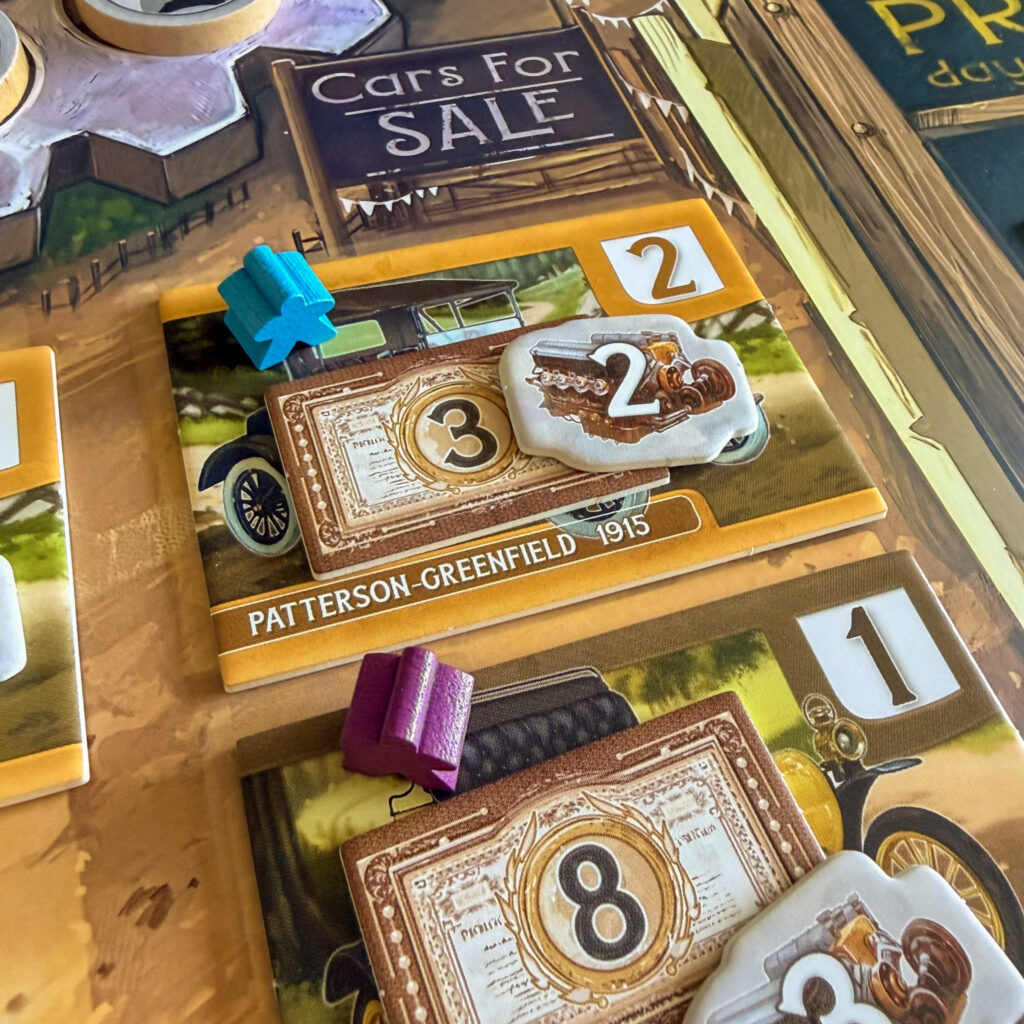
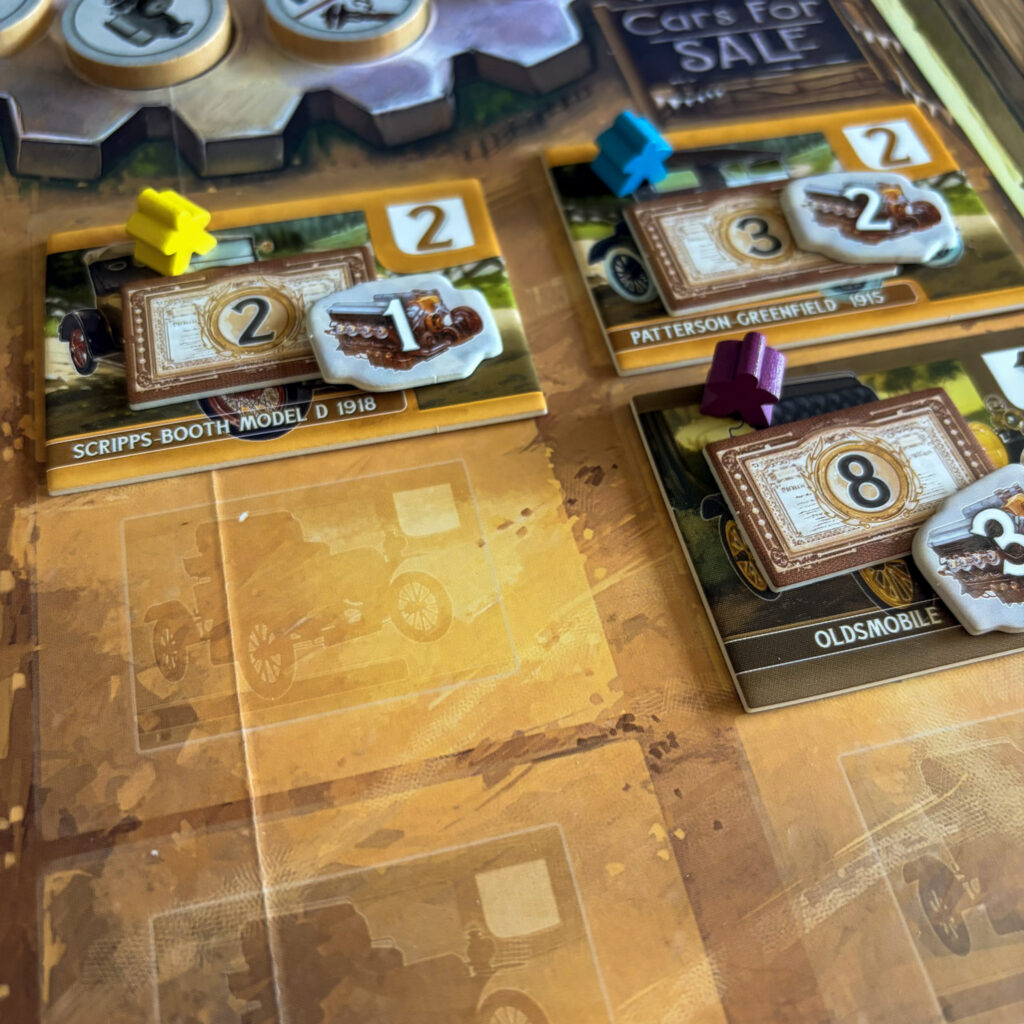
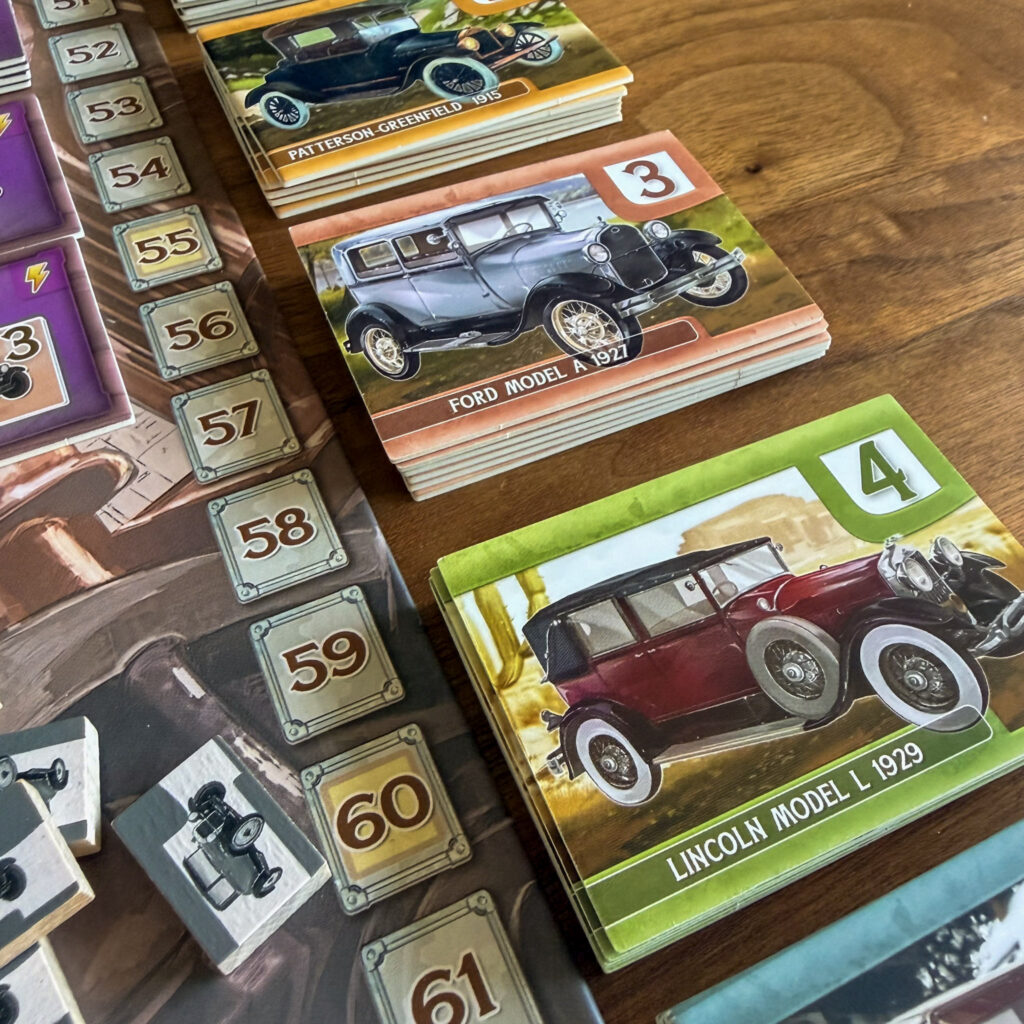
After resolving their chosen actions, players may place a car on the Market. To do so, they combine one Engine, one Car Body, at least one Worker or Sales Staff member, and a selected Price Marker. The resulting vehicle is then offered for sale. Deciding when to place a car on the market and at what price is a crucial part of the game, as buyers will later evaluate these cars according to their personal preferences.

The Action Phase continues until either all six Market spaces have been filled with cars or the Market Marker reaches the end of its track. At that point the round immediately moves into the Scoring Phase.
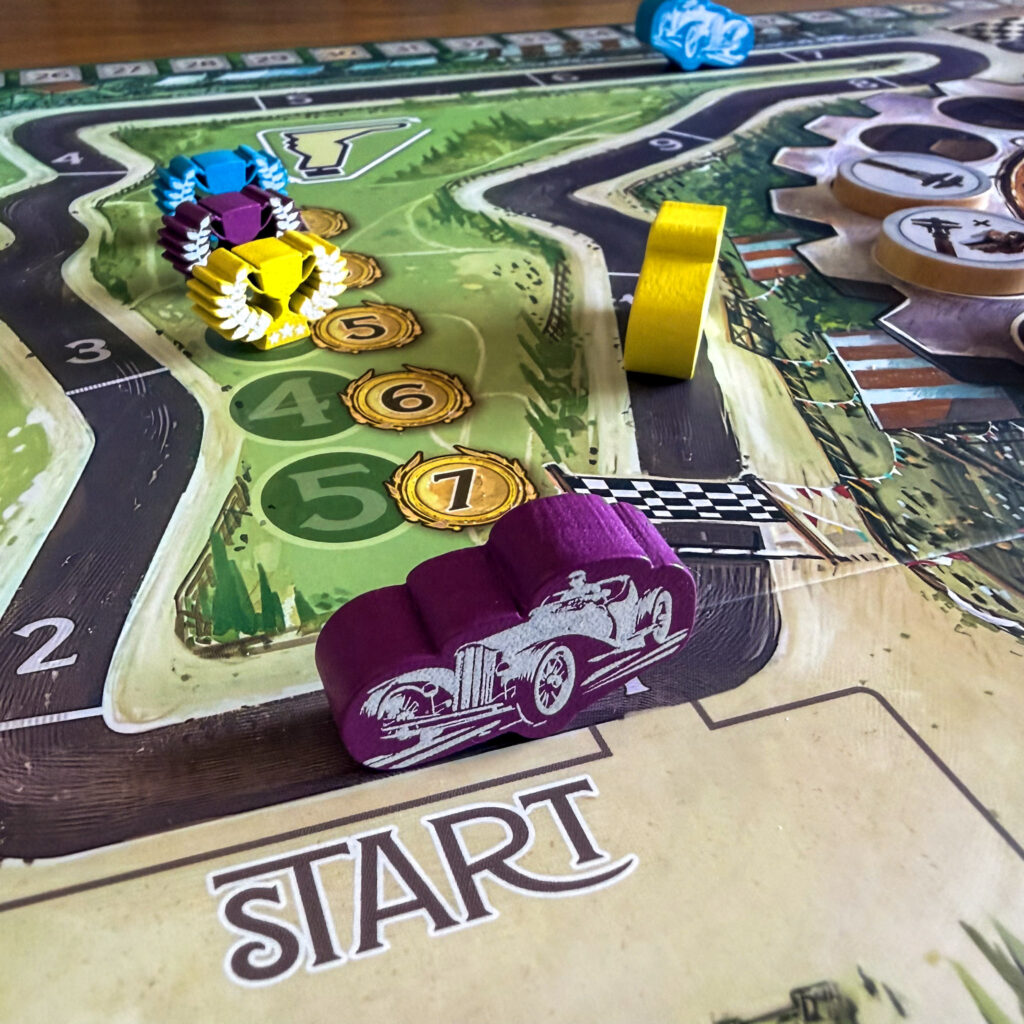
Scoring begins with the Grand Prix. Companies earn Reputation Points based on their position in the race as well as the number of laps completed by their racing car. Investing in stronger engines and a capable racing team can therefore provide valuable prestige throughout the game. Once the race has been scored, attention shifts to the marketplace. Active Buyers purchase cars according to their preferences, whether they value powerful engines, advanced car bodies, luxury features, or attractive pricing. Investors may then purchase additional vehicles if suitable options remain available. Whenever a company sells a car, it gains Reputation Points equal to the value of the car’s Price Marker, creating a constant tension between setting ambitious prices and ensuring a successful sale.
Throughout the game, players can also earn additional Reputation Points by claiming Achievements. These rewards recognise important milestones such as developing advanced engines, recruiting multiple engineers, attracting buyers, leading the Grand Prix, or expanding production ahead of competitors. Because each Achievement can only be claimed once, there is often a race to secure these bonuses before opponents do.
After the Scoring Phase of the third round, the game comes to an end. The company with the highest total number of Reputation Points is declared the winner and earns its place among the legendary pioneers of the North American automobile industry. In the event of a tie, the company that recruited the most Engineers wins. If the tie still remains, the tied companies are considered to have merged and share the victory.
Final Conclusion & rating
Weight: 2.88/ 5
Replayability: 7
Our rating: 7 out of 10 dices
Kraftwagen: Age of Engineering is a very successful reimplementation of Matthias Cramer’s original design. It combines a clever action-selection system with an engaging market mechanism, creating a game in which timing, planning, and reading your opponents are every bit as important as developing better engines and car bodies.
The constant tension between technological progress, racing success, and selling cars at the right moment ensures that players are rarely short of meaningful decisions. The elegant action-wheel mechanism and the interactive market are the game’s strongest features, especially because a single decision can dramatically influence what happens during scoring.
Our experience was greatly enhanced by playing with the Deluxe Edition components. The upgraded pieces, premium tokens, and overall table presence bring the theme to life and make the game feel far more immersive. Watching your company grow while placing beautifully produced components onto the board adds a level of satisfaction that the standard edition simply cannot match. The deluxe production gives the game a presence worthy of the industrial era it represents.
Player count is perhaps the most important consideration. While the game technically supports two to four players, we strongly agree with the common consensus that three and especially four players offer the best experience. With more competitors fighting for buyers, manipulating the market, and competing for achievements, the game becomes significantly more interactive and unpredictable. The automotive market feels tighter, competition for sales becomes fiercer, and every decision carries greater consequences. At lower player counts, the market can feel more forgiving, reducing some of the tension that makes the game shine. Multiple reviewers came to a similar conclusion, noting that the game truly comes alive when the table is filled with ambitious car manufacturers battling for prestige.
Not everything is perfect. Some players may find that the available Engineers, Investors, and Achievements become familiar after repeated plays, slightly limiting long-term variability. In addition, experienced Eurogamers looking for a highly complex strategic challenge may find the game somewhat lighter than expected.
Nevertheless, the combination of accessible rules, meaningful decisions, strong thematic integration, and an excellent market system makes this an enjoyable and rewarding experience.
In the end, Kraftwagen: Age of Engineering delivers exactly what it promises: a fast-moving and highly interactive race to become the most prestigious automobile manufacturer of America’s engineering boom. If you can gather three or four players around the table and have access to the deluxe components, you are in for the most complete and enjoyable version of this experience. It may not reinvent the Eurogame genre, but it certainly provides a highly entertaining ride that is well worth taking. 🚗💨
🙏 Thanks to Arcane Wonders for providing this review copy and the opportunity to write about it.